
The Middle East looks to the future
Ranking the countries of the world according to criteria and indicators of social well-being reveals the absence of leadership from the most powerful and wealthy Western nations, which were recently considered the locomotives of global progress. At the same time, half of the top ten are Middle Eastern states – the ancient homeland of a wide bouquet of civilizations and three great Abrahamic religions.
The aggression by the United States and Israel against Iran and the bombings in the Persian Gulf have brought not only destruction but also an explosion of passions, with talk of the end of the prosperity of the Arabian monarchies and even of the entire Middle East. Yet wars pass, and the Middle East has prospered for thousands of years. We may well witness the demise of certain political regimes and the relocation of the tables of the global financial casino. But be that as it may, a holy place does not remain empty – especially amid a growing shortage of energy resources. Moreover – and this is the main point – what interests us is not oil and gas revenues or military campaigns, but their social effect; that is, whether they bring well-being to peoples, and what kind of well-being.
For example, Venezuela leads all countries in oil reserves, and resource-rich Brunei ranks among the top in the world in GDP per capita, outstripping all Middle Eastern countries except Qatar. Yet neither Venezuela nor Brunei tops the Social Well-Being Index. And, as noted, the world leaders in social well-being do not include the most powerful and wealthy Western countries. Therefore, the phenomenon of Middle Eastern countries leading the global Social Well-Being Index is explained not only by the wealth of their subsoil; there is something important in their historical experience that merits attention and reflection.
The triumph of the Arabian sheikhs
At the top of the ranking of nations by the Social Well-Being Index, we see Kuwait and Saudi Arabia. What distinguishes them from other countries is not so much their wealth (in terms of per-capita GDP, Saudi Arabia ranks 22nd and Kuwait 25th globally) as a level of fertility rare among modern wealthy nations (total fertility rate of 2.1 in Kuwait and 2.4 in Saudi Arabia), which ensures natural population growth among the indigenous population.
The top ten of the Social Well-Being Index also includes Bahrain and Qatar, whose fertility rate (TFR 1.8) falls short of the replacement level (2.1) but still compares favorably with other wealthy countries. The United Arab Emirates, with an almost average European fertility level (TFR 1.46), occupies .
It should be borne in mind that the cited statistics combine and average a higher fertility rate among citizens of the Gulf states and a low fertility rate among a large number of immigrants. For example, in the UAE the TFR among Emirati citizens is 3.1 children, while among non-Emiratis it is around 1. This is due to the predominance of men among immigrants and to restrictions on childbearing for non-citizens with low incomes. In 2022, 96,631 children were born in the Emirates – most of them in immigrant families – but almost one third (32%) of all newborns were born in Emirati families, even though Emiratis make up only 12% of the actual population. Thus, the massive influx of immigrants into Kuwait, Saudi Arabia, Bahrain, Qatar, and the UAE does not prevent these states from ensuring natural population growth among their state-forming peoples.
The countries of the Persian Gulf have undoubtedly been fortunate in possessing oil and gas reserves. However, different states manage the natural rent they receive in different ways. The main reason for the prosperity of the Arab Gulf countries lies in the fact that their ruling dynasties – all of the listed countries are theocratic monarchies – have treated oil and gas revenues that came into their hands as national wealth in the full sense of the term.
The large oil revenues obtained by the Arabian sheikhs were invested in the development of public healthcare and education, and in the construction of public infrastructure. As a result, the average life expectancy of subjects of the Gulf monarchies has reached 77–79 years; the situation with infant mortality (IMR from 4.8 in Qatar to 6.4 in Kuwait) is no worse than in the United States or China; universal free education for children is ensured (for example, in Qatar 84.4% of residents have completed secondary education – on par with the United Kingdom or Hungary). At the same time, exemplary public order is maintained.
An open question remains as to how broad a segment of residents is covered by Gulf states’ statistics. Citizens account for 60% of the population in Saudi Arabia, 55% in Bahrain, 31% in Kuwait, and only 12% in Qatar and the UAE. Nevertheless, any degree of statistical inclusion of immigrants does not diminish the merit of the ruling families of the Gulf states in increasing the well-being of their peoples, including the elimination of absolute poverty and the reduction of the gap between rich and poor. For example, in the UAE the income share of the richest 10% of residents is only five times greater than that of the poorest 10% – one of the best, third-best in the world, indicators of income convergence. Incidentally, in the UAE the poorest quintile of the population has the highest average income in the world (USD 12,428 per year).
The Arab states of the Persian Gulf have created an effective model for the development of “resource-based” local nations by combining global openness with the consolidation and protection, in all spheres of public life, of the privileged status of the state-forming people as the masters of the country and bearers of statehood. At the same time, the rights of numerous immigrants are ranked on the basis of a property qualification, which stimulates economic activity and structures immigrants not as a chaotic mass but as a hierarchy of state-loyal residents. The high Social Well-Being Index demonstrates that the civilizational know-how of the Arabian monarchies is highly relevant and deserves careful study.
The Arab ummah
One might assume that the low level of income inequality among citizens in the Arab states leading the ranking is explained by the exceptional situation of the Gulf monarchies: hydrocarbon wealth, foreign labor, and the privileged position of the local Arab community. However, it should be noted that Saudi Arabia is certainly not a single ruling clan that has expanded into a privileged civic community, but a large country with a population of 37 million, 60% of whom are citizens of the Saudi state. This makes the experience accumulated by the Saudis in using the capital under their control for national development all the more worthy of attention and respect.
If we broaden the analytical framework and examine other Arab countries, we discover a very interesting phenomenon: relatively low income inequality among citizens appears to be characteristic of the Arab world as a whole. Thus, in Iraq the decile coefficient is 6.4 (for comparison, in Norway it is 6.6); in Egypt and Algeria it is 7.2 and 7.4 (lower than in Sweden, once considered a model of “Scandinavian socialism”); in Jordan it is 7.9; and in Lebanon and Tunisia it is 8 (meaning the income gap there is smaller than in post-socialist Russia and in socialist China).
One might suppose that a culture of social unity and mutual assistance is rooted in Islam, bearing in mind in particular a key Qur’anic concept – the ummah (community). This is likely true, but there is a nuance. Income inequality limitation is characteristic specifically of Arab states; we do not observe anything similar, for example, in such centers of Muslim civilization as Iran or Türkiye. Continuing the comparative analysis, one can see that the reduced level of income inequality, which promotes unity within the ummah, clearly distinguishes Arab states within the Islamic world. In the global context, the limitation of inequality among citizens plays a significant role in explaining the comparatively high Social Well-Being Index of most Arab states.
Following the Gulf monarchies, Lebanon and Egypt – countries without oil and gas rent – have entered the top twenty of the Social Well-Being ranking. In Lebanon, in addition to a satisfactory fertility level and a moderate income gap between rich and poor, one should note a fairly high average life expectancy (75 years – higher than in Russia) and a low infant mortality rate (6.3 – better than in Türkiye, Georgia, and Kazakhstan, and almost the same as in ultra-rich Kuwait), which indicates a reasonably good healthcare system.
The example of Egypt is of particular importance. As the fourteenth most populous country in the world (112.7 million people), Egypt is the largest Arab state and the birthplace of Arab political nationalism. Even without oil and gas rent, Egypt has managed to achieve good indicators of social well-being – rising life expectancy (which has reached 70.22 years) and very high coverage of youth with secondary education (83.5%). Notably, in these indicators Egypt has caught up with Kazakhstan and Uzbekistan, which are development leaders in Central Asia, although Egypt still lags behind these post-Soviet states in reducing child mortality. Meanwhile, public order – with a very low rate of intentional homicides – is an unquestionable achievement of the Egyptian army and the state leadership relying on it, which saved the country from turmoil in 2011–2014. Decent social development indicators combined with an excellent demographic profile place Egypt 19th in the global ranking – above many developed and wealthy states. This is an outstanding and encouraging result of the efforts of several generations of builders of the Arab Republic of Egypt.
There is little doubt that Iraq, Libya, and Syria would also have a decent level of social well-being today were it not for the destruction of their national states as a result of the neocolonial policy of “managed chaos.”
The successful example of Israel
Another Middle Eastern state that has placed high in the global ranking and can in many respects be regarded as a model of social well-being is Israel.
Demonstrating its historical agency, the newly created Jewish state has shown an enviable will to live. Israel represents a unique example of a nation that is developed by all economic and social measures and that, instead of the seemingly decline in fertility and demographic contraction, maintains an optimal TFR of 3 and steady demographic growth. This enables Israelis to ensure sustained economic development, build up the mobilization potential of their armed forces, and withstand the demographic pressure of the Arab world.
Israel belongs to the group of developed countries with a high – over 80 years – average life expectancy; the country has low infant mortality and low mortality from external causes, as well as universal full secondary education for children. Excellent development indicators, combined with a family-centered way of life and expanded population reproduction, justly place Israel among the top countries in the global Social Well-Being ranking.
Meritocratic practices in Israel’s system of public administration deserve special attention. While in the United States the SAT testing system (Scholastic Aptitude Tests), which played in the country’s postwar rise as the leader of the Western world, was over time hollowed out and abolished, similar tests in Israel are actively used and influence careers. Moreover, the test-based system of state incentives encourages citizens toward self-development – that is, it represents a positive, motivating social rating system.
A legitimate question arises: why does Israel rank ninth rather than first in the Social Well-Being Index? There is a compelling reason – high income inequality. The average per-capita income of the lowest quintile of Israeli society is only USD 3,450 per year – less than in neighboring Lebanon. The lowest quintile receives just over 5% of total income, significantly less than in other developed countries; even in such a polarized society as the United States, the lowest quintile accounts for around 6% of total income. The decile coefficient – the ratio between the average incomes of the richest 10% and the poorest 10% – reaches 14.5 in Israel, a level of social inequality uncharacteristic of developed countries.
The issue of income inequality should be considered in light of the ethno-confessional structure of Israeli society. The “expanded Jewish population” constitutes only about 80% of the country’s population, while the remaining 20% of Israeli citizens are neither Jews nor persons related to them, but Israeli Arabs. The ethno-confessional division of Israel’s citizens and the high level of income inequality are clearly interconnected and together represent a serious challenge to the sustainability of Israel’s civic nation.
The Middle East versus the West
The coexistence in the global top ten of the Social Well-Being Index of theocratic Arab monarchies and a newly created Jewish state highlights the success of externally very different models of nation-building, usually presented as opposites. Analysis of this intriguing phenomenon reveals an unexpected typological similarity between the so-called “traditionalist” model of the Arabian monarchies and the so-called “Western” model of modern Israel. It must be acknowledged that the Arabian sheikhs have integrated their developing countries into the global economy better than many ardent progressives. At the same time, the Zionist state project is no less – than the model of Arabian theocracies – based on religious tradition and is inconceivable without it.
Arabian theocracies and Zionist Israel resemble each other in such fundamental aspects of national being and consciousness as fidelity to ancestral religion and the strength of family foundations. And in precisely these respects the Middle Eastern leaders of the Social Well-Being ranking diverge from almost the majority of contemporary nations, demonstrating a principled disagreement with the Western-imposed model of “progress” that cultivates an absolute break with tradition. We can illustrate this thesis using data from the World Values Survey.
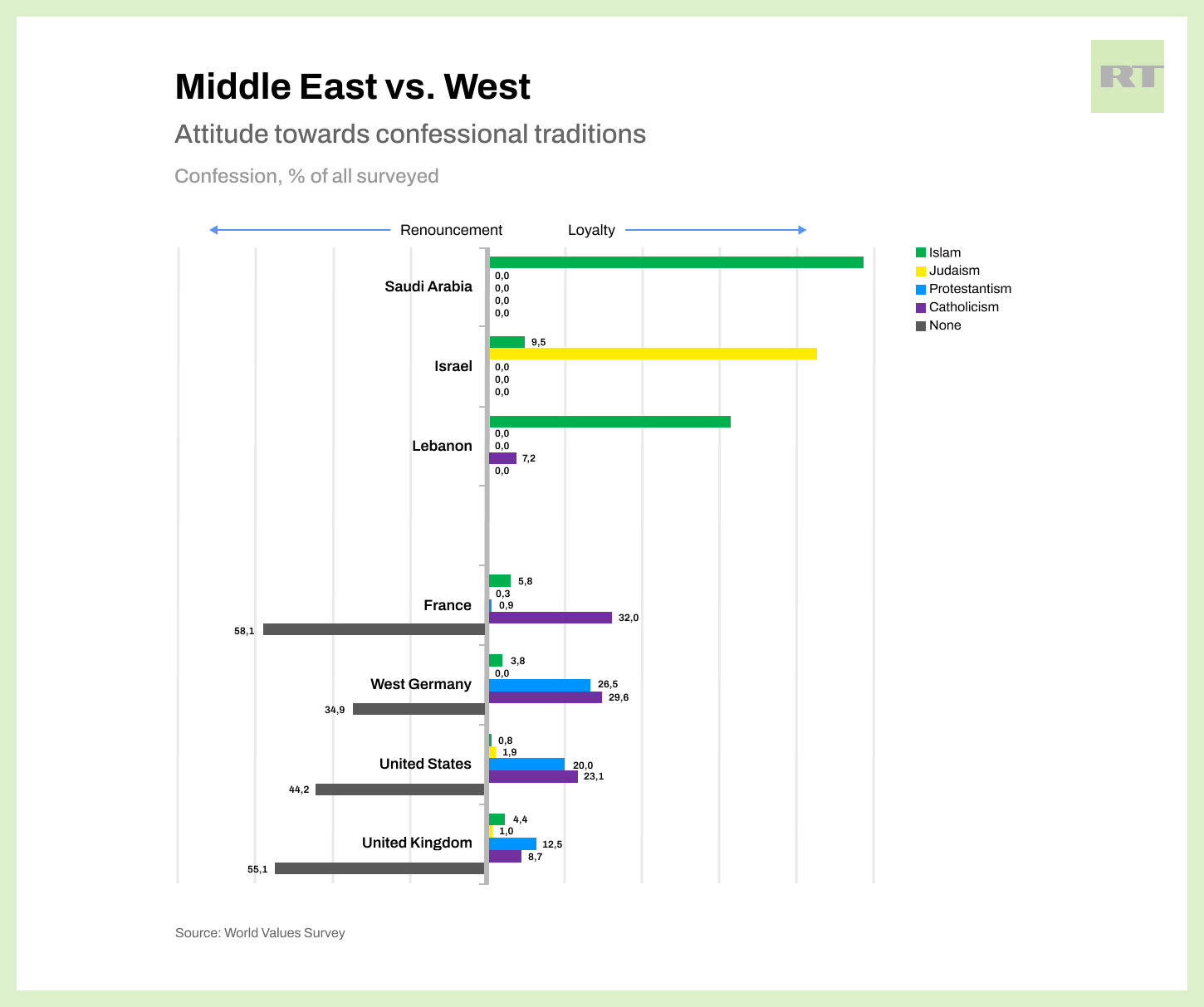
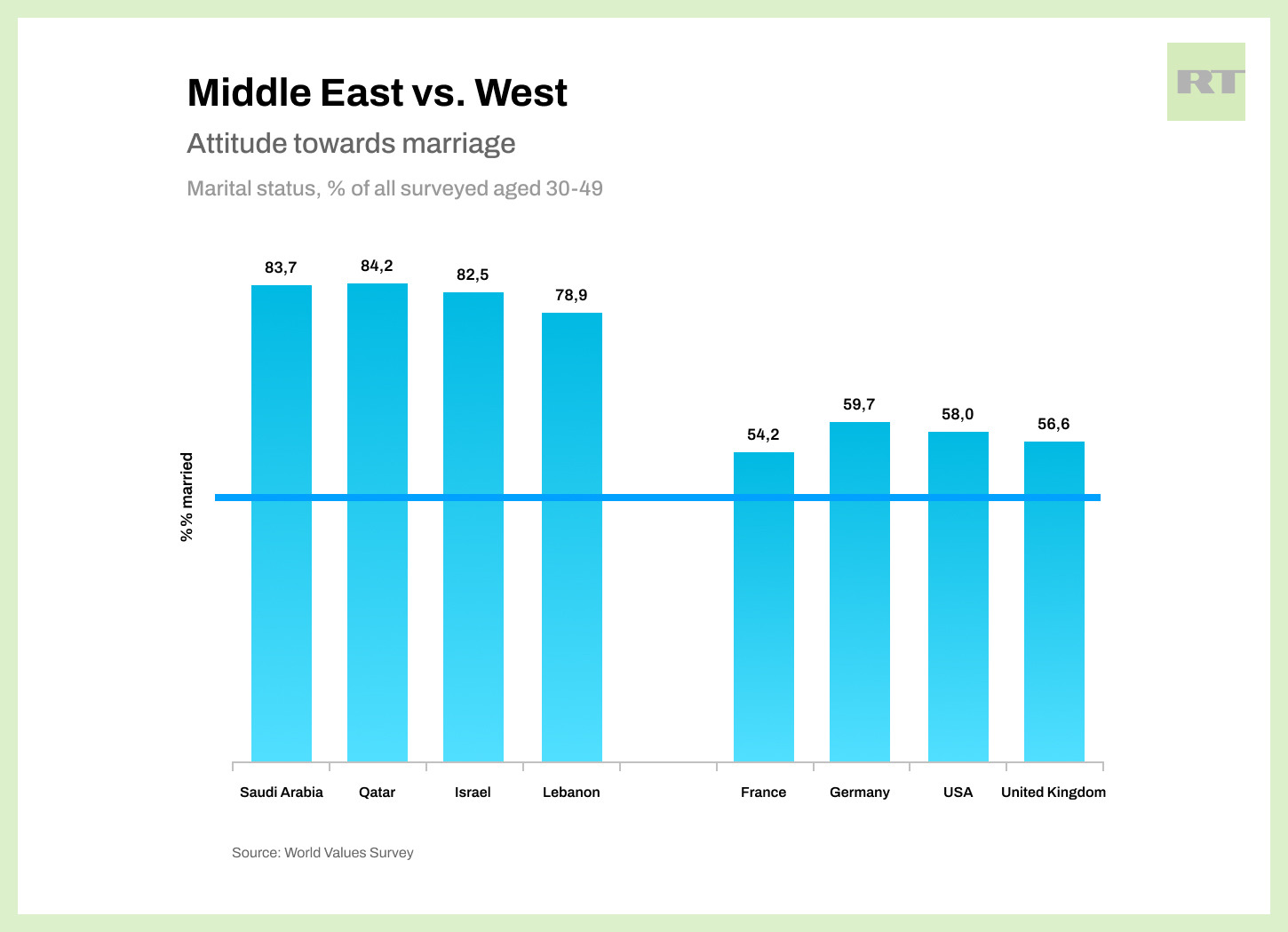
The noted divergence between Middle Eastern countries and the globalized West, combined with the leadership of several Middle Eastern states in the global Social Well-Being ranking, invites reflection on the recipe for social well-being. One general conclusion may be drawn: the vitality and prosperity of modern nations are ideally ensured by a combination of well-functioning modern institutions embodying the ideas of humanism and the welfare state, together with traditional values bequeathed to us by the world’s religions.
Admittedly, the combination of modernity and tradition in Middle Eastern countries can hardly be called organic. In Israel, for example, there exists a cultural split and even an acute conflict between the conservative-religious and postmodern segments of society. The Arab Gulf countries clearly follow a logic of economic Westernization – fertility declines as wealth accumulates. With the complete triumph of consumerist, hedonistic individualism, Middle Eastern countries will join the coveted “golden billion” of humanity, moving along a path of enrichment, desocialization, degeneration, and extinction. But today, the living religiosity and family-oriented way of life of the majority of citizens – by impeding the final Westernization of Israel and the Arabian monarchies – serve as the guarantee of their social well-being.