
Canada as a showcase of globalization
Canada ranks 13th in the global Social Well-Being Index, immediately after Japan. Thus, two G7 member states display fairly high levels of social well-being, calculated using data from the early 2020s. This can create the impression that social decline is not a general trend across the entire globalized West. However, having examined such a model product of Westernization as contemporary Japanese society, we became convinced that social decline is in fact the very essence of its evolution. Now let us consider the example of Canada.
A Canada past its bloom
At first glance, Canada appears to have only one clearly unsatisfactory indicator of social well-being: its total fertility rate (1.4), which is below the population replacement level (2.1). Still, this flaw seems correctable: low birth rates are more than compensated for by immigration, which ensures steady population growth.
The level of social inequality is also cause for concern: Canada’s decile coefficient (8.4) is noticeably higher than in many EU countries. Yet, on the other hand, this Canadian figure is lower than the decile coefficients of socialist China and post-socialist Russia, not to mention such flagships of the capitalist world system as the United States and the United Kingdom.
All other indicators of social well-being in Canada look quite good: life expectancy exceeds 82 years, infant mortality is below 4 per 1,000, intentional homicides are rare, and youth participation in complete secondary education is high.
Canada’s self-presentation on government websites is sustained in the spirit of advertising brochures: “Canada is one of the richest and most prosperous countries in the world, with a high per capita income.” “Canada’s global reputation as a highly developed, peaceful country free from ethnic unrest and conflict, where children can be raised in a calm environment, undoubtedly contributes to rising immigration.” “Canada is known for its universal healthcare system and overall care for its citizens, funded by relatively high tax rates of 33% on personal income and 15% corporate taxes.”
However, a closer examination of Canadian realities reveals that all these indicators are subject to rapid devaluation. The quoted messages from government websites resemble the light of a distant star – the information they convey refers to a phase in the evolution of the universe that has already passed.
Canada’s rapid economic growth after World War II transformed it from a predominantly rural country into an urbanized, highly developed industrial and post-industrial state. This success was driven by three factors:
- a powerful resource base for an export-oriented economy (hydrocarbons, timber, zinc, uranium, gold, nickel, aluminum, electricity, food);
- deepening economic integration with the United States;
- the attraction of skilled labor and specialists from abroad.
Key milestones in this development were the 1988 Free Trade Agreement (FTA) between Canada and the United States, followed by the 1994 North American Free Trade Agreement (NAFTA), which brought Mexico into the free-trade zone. Thus, simultaneously with the launch of the European Union project – which, after the collapse of the Soviet bloc, gained space for economic expansion in Eastern Europe – an even more powerful core of the globalized West was created in North America.
Canada appeared, if not the main beneficiary of globalization, then at least its impressive and attractive showcase. Canadian elites shared and promoted the “Washington Consensus” regarding the dominance of transnational capital denominated in dollars, the weakening of nation-states, and the U.S. monopoly on global violence. In the postmodern world of the “end of history,” Canada – acting as a privileged exporter for the United States and bearer of the global brand “a country of immigrants” – seemed to have the brightest prospects. Canadian prosperity is usually illustrated by charts of brisk GDP growth, where the country of the maple leaf appears as a happy satellite of the United States.
The economy of Canada
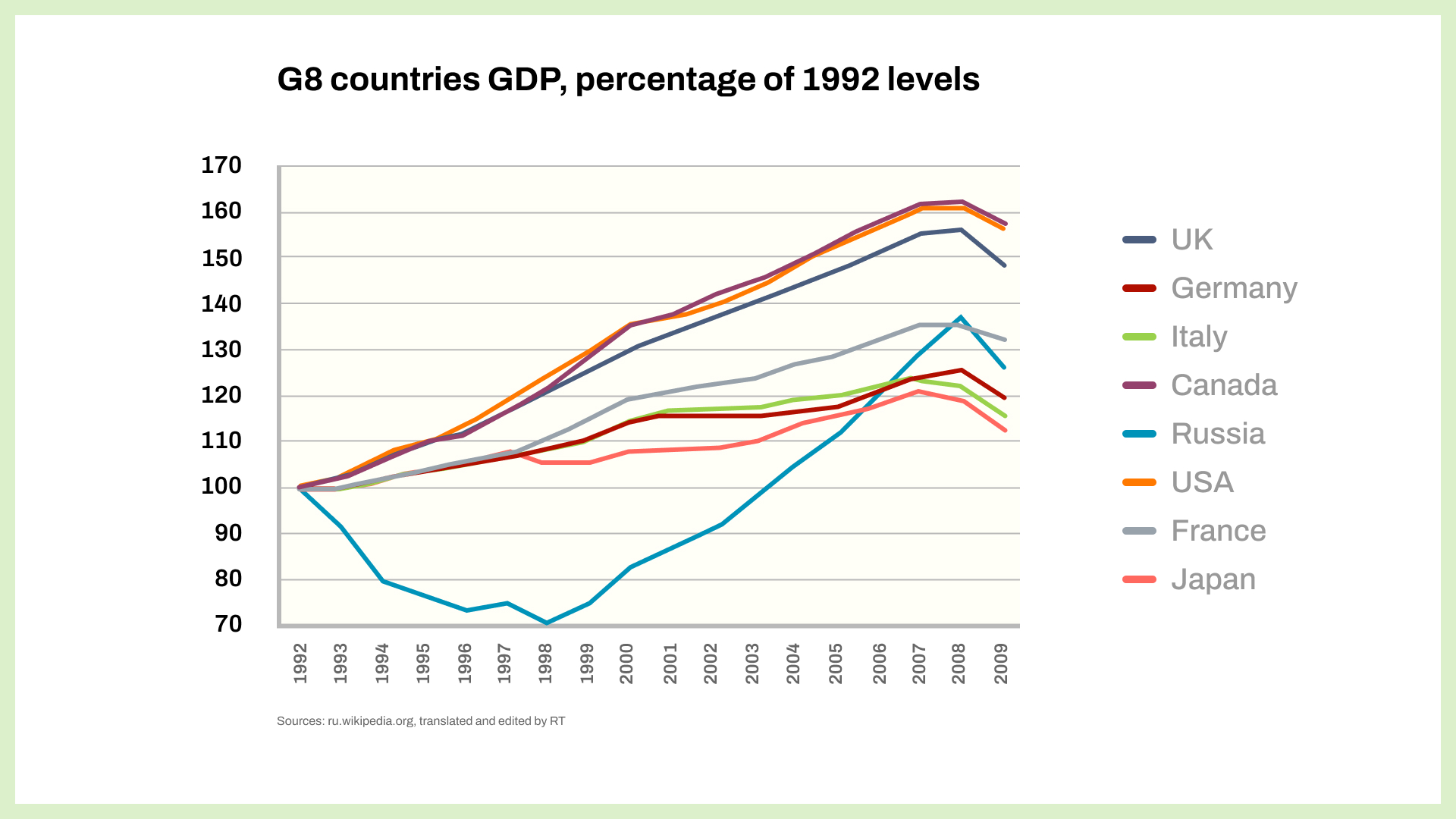
Alas, prosperity has ended. Domestic and international observers note an almost decade-long depression in the Canadian economy and attempt to identify its causes while avoiding strategic generalizations. Meanwhile, the Canadian crisis is merely a reflection of the structural crisis of globalized financial capitalism. Moreover, the main factors behind Canada’s past success – proximity to the United States and large-scale immigration – have now turned into risk factors. The scale of the problem is evident in the chart showing current dynamics of real GDP per capita in the G7 countries.
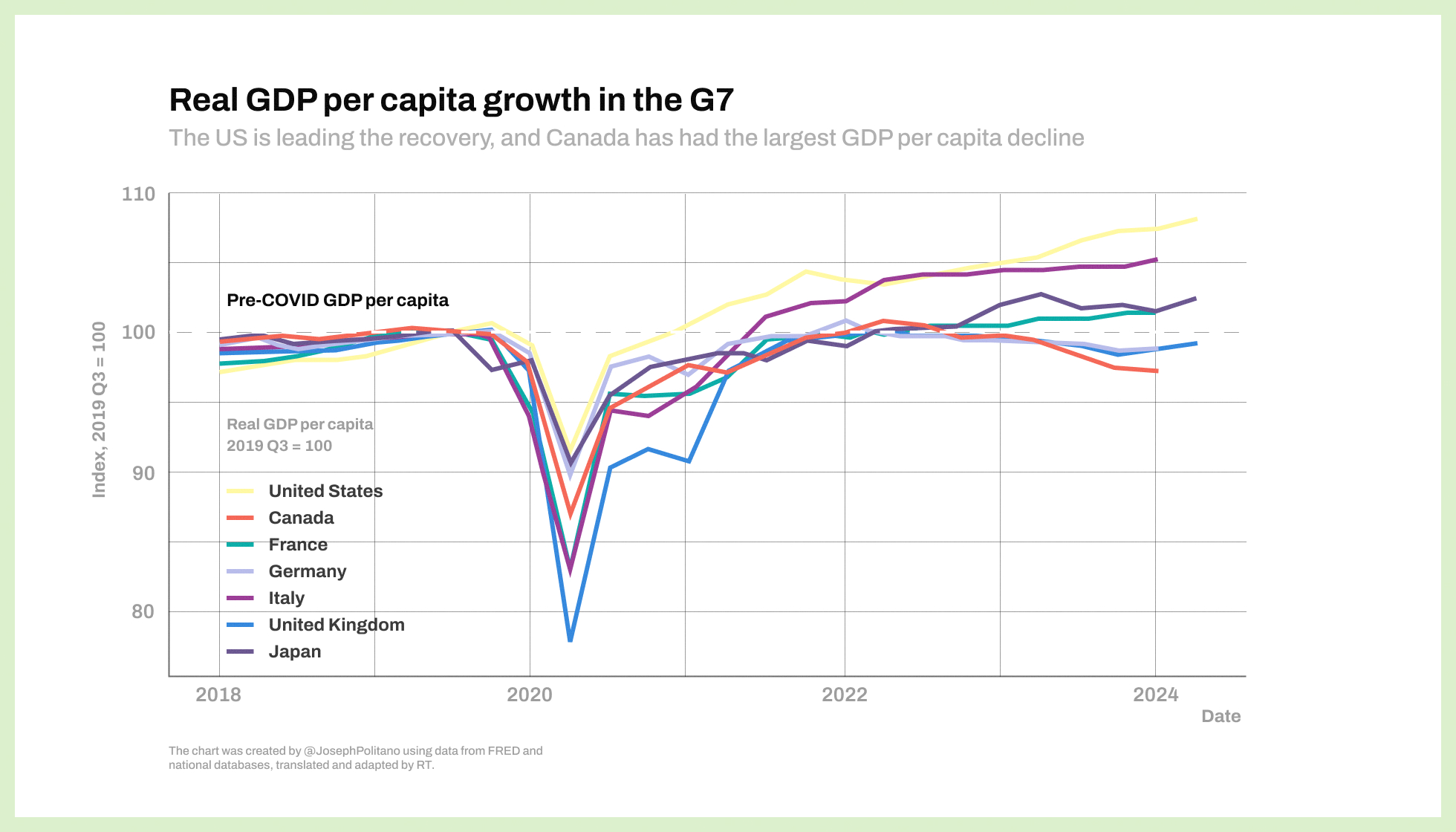
As we can see, over the six years from 2018 to 2024, Canada’s real GDP per capita did not grow but declined. Moreover, Canada posted the worst result among G7 countries (minus 3%).
Now let us compare Canada’s negative real GDP per capita dynamics with the positive dynamics in the United States and reflect on the following. GDP is a deceptive indicator, rather poorly reflecting the real economy. In the United States, for example, nominal GDP growth has coincided with significant deindustrialization and ongoing infrastructure decay, since real production and capital repairs are by definition unprofitable, while serious profits are extracted only from financial speculation. If statistical GDP growth masks mounting economic crisis and social decline in the United States, it is frightening to imagine what lies behind Canada’s officially acknowledged decline in per capita GDP.
A country without a nation
The divergence in GDP dynamics between Canada and the United States, as shown in the chart, occurred in 2022. Germany’s economy also declined at the same time. But while the slowdown of Europe’s economic locomotive is linked to the blockade of energy imports from Russia, Canada should, seemingly, have benefited from Europe’s difficulties – together with the United States. So what is the problem?
Let us compare the break in Canada’s real GDP per capita trend in 2022 with the assessments of the well-known Russian economist Mikhail Khazin, according to whom a structural downturn in the U.S. economy began at the end of 2021. It appears that Canada’s crisis, as befits a satellite economy, reflects the crisis in the United States. At the same time, Canada – whose public debt doubled between fiscal years 2014–15 and 2024–25 and now exceeds GDP – cannot, unlike the United States, solve its financial problems through monetary emission.
The condition of Canada’s globalized and essentially satellite economy is determined by the external geo-economic context, which today is shaped by two interconnected factors. First, the model of globalization upon which Canada pinned its hopes has collapsed and self-destructed. Second, as the world-system of financial capitalism disintegrates, U.S. hegemony is transforming into rigid imperialism, ensuring the survival of the Western hegemon through the assimilation of all resources it can reach. These metamorphoses caught Canada off guard and force it to once again answer the question: to be or not to be.
Donald Trump’s selection of Canada, Greenland, and the Panama Canal as priority targets of his imperial policy is determined not only by U.S. strategic interests, but also by the weakness of existing state sovereignty over these objects. When speaking of sovereignty, people usually consider a state’s resources, yet the primary condition of sovereignty is the subjectivity of the sovereign – which in modern discourse implies the historical existence of a nation, recognized and defended by its citizens as the highest value. With respect to the mentioned objects, Canada included, the subjectivity of the sovereign nation is precisely what is in doubt.
Who are Canadians? De jure, they are all Canadian citizens, whose number – primarily through immigration – while natural population growth accounts for only about one-tenth of total annual growth. Thus, every year the country of the maple leaf gains more and more “new Canadians,” that is, naturalized citizens and their children, and fewer “old Canadians,” not only proportionally but also . In 2001, only 39% of Canada’s residents identified themselves as descendants of settlers from Britain, Ireland, or France, and in the 21st century this historical core of the nation has been shrinking even faster, visibly diminishing.
Between 2016 and 2021, only 17% of immigrants arriving in Canada were white (and for only a few of them was English or French a native language), while about 60% of immigrants came from Asia, especially China and India. As a result, according to the 2021 census, nearly one in five Canadians originates from Asian countries; immigrants from Latin America and the Caribbean account for about 5%, and those from Africa 4% of Canada’s population. At the same time, the share of Indigenous peoples – Indians and Inuit – has been preserved and even increased, reaching 5%.
To this must be added the longstanding cultural and political opposition of French Canadians, which transformed into Quebec nationalism and manifests itself in nearly all major decisions, including such fateful ones as participation in World War II and the signing of the Constitution Act of 1982.
Thus, the answer to the question “Who are Canadians?” is far from obvious, and today it is even less clear than before. Most likely, self-identification is decisive. One can gauge how strongly Canadians feel Canadian by examining census data. In 2001, 32.22% of citizens defined their ethnic origin as “Canadian” (including 22.77% as their sole response). Twenty years later, in the 2021 census, among a wide range of “ethnic or cultural origin” definitions, only 15.6% of respondents chose “Canadian.”
The fact that respondents could indicate multiple ethnic groups only worsens the situation: they were not required to limit themselves in any way and could freely define their ethnic affiliation, optionally adding the politically correct answer uniting all citizens. Yet 84% still avoided calling themselves Canadian.
It should be noted that 2021 also set an immigration record, with 405,330 newcomers. That record was quickly broken, as immigration took on tsunami-like proportions. Whereas in the 1990s and 2000s net immigration averaged about 200,000 per year, it now stands at 1.2 million annually.
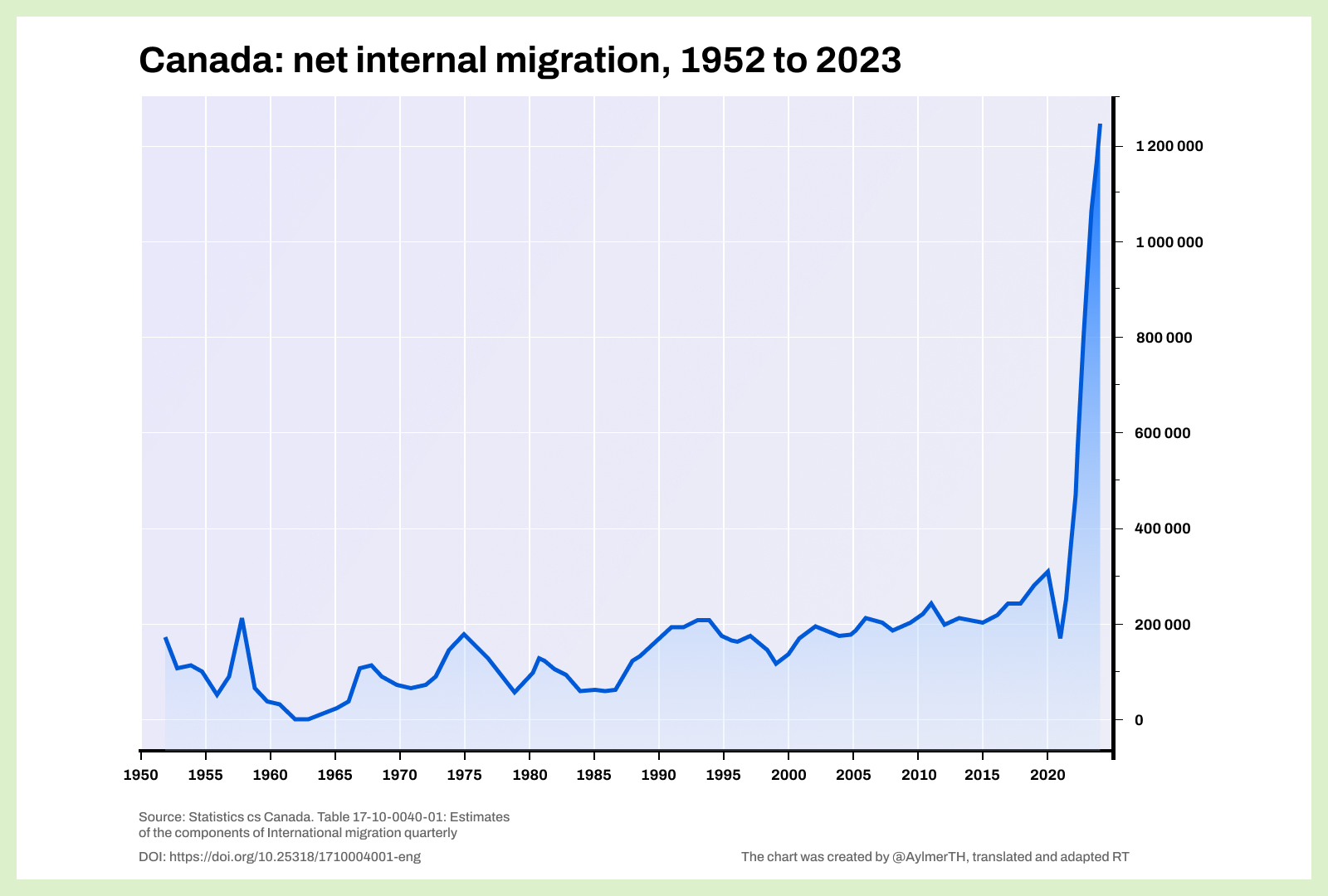
The reason is that the Canadian government responded to the economic depression and GDP decline during the pandemic year of 2020 with an old, proven method – immigration, intended to expand consumer demand and the tax base while preventing population aging. This is not the policy of a single government, but a fundamental strategy of the Canadian elite, codified in the early 1990s in recommendations by the Economic Council of Canada to increase immigration so as to eventually raise Canada’s population to 100 million.
At the same time, Canadian experts acknowledge that immigration has no statistically significant impact on . Yet this position is also disingenuous, since it is obvious that immigration negatively affects per capita GDP growth: one need only compare Canada’s sixth place globally in per capita GDP in 1981, when the population was 25 million, with its current 23rd place with nearly 40 million people. Moreover, studies have shown that taxes paid by immigrants do not exceed associated , and that immigration cannot preserve the youthfulness of Canada’s population and may even contribute to in the long run.
Nevertheless, the strategy of population and GDP growth through immigration has never been reconsidered. The mega-project of importing “human capital,” steadily implemented amid declining productivity and accelerating fertility decline among the native population, demonstrates a complete atrophy of national feeling among Canada’s elites. This is hardly surprising, since nearly all Western elites have ceased to be national, becoming products and carriers of the Globalist Project. Justin Trudeau was not engaging in provocation but in progressive branding when he declared that “there is no core identity in Canada” – that is, no dominant nationality rooted in the country’s history. Well then, let us assess the results of the “first post-national state.”
The Canadian lesson
In the early 2020s, the Canadian government lowered immigration point requirements and opened the door to low-skilled immigrants in order to reach its target of 400,000 immigrants per year. Notably, this immigration surge occurred amid years of underinvestment in manufacturing, housing construction, infrastructure, and technology. The Canadian lesson is that attempting to compensate for lack of investment and declining productivity with increased immigration is a very bad strategy.
Maximizing the inflow of workers and students triggered a long-brewing housing crisis. Rental and home purchase prices multiplied. In a December 2024 Abacus Data survey, 58% of respondents expressed concern that they would be unable to pay their mortgage or rent; among those aged 30–44, 66% shared this concern. According to the National Bank of Canada, servicing debt on a typical Canadian home consumes 67.3% of a worker’s salary. Interest rates have forced nearly half of mortgage holders to take out new loans to service existing debt, while 20% already have overdue payments.
The Fraser Institute described the situation as the most serious decline in living standards in four decades. Canadian food banks report record demand; according to a poverty report, nearly seven million Canadians struggle to feed themselves as the cost of living and housing crisis continue to rise.
Opinion polls show unprecedented dissatisfaction and pessimism. An Ipsos survey found that 7 in 10 Canadians agree that “Canada is broken,” rising to 8 in 10 among those aged 18–34. According to an Angus Reid poll, 42% of Canadians have considered emigrating. Statistics Canada reports that current emigration is already 31% higher than the historical average.
Economic depression and the housing crisis forced the government to take an unthinkable step: in 2024, the number of incoming student visas was cut by 35%. Yet attracting foreign students is a major sector of Canada’s economy, an institutional recruitment channel for talented youth, and for , an informal route to immediate labor immigration.
Police the government that it would struggle to contain anger over worsening economic conditions and rising youth dissatisfaction. After the mass “Freedom Convoy” protests of 2022, such warnings sound especially alarming. Analysts believe the coming recession will accelerate the decline in living standards already affecting younger generations. Many Canadians under 35 are unlikely ever to own a home. This decline will be compounded by the fact that the wealth gap is “larger than ever in several generations.” Homeownership has become unattainable for a record number of Canadians: only 26% of households can afford a single-family home. Report authors even suggest that Canada could fragment under pressure from economic crisis, environmental catastrophe, and territorial disintegration.
Economic difficulties are compounded by demographic trends. Canada’s fertility rate fell below replacement in the 1970s. Immigration helped sustain an aging population by importing labor. But “new Canadians” did not have more children than “old” ones, and fertility continued to decline, sharply accelerating during a decade of economic depression. In 2022, 351,000 people were born and 325,000 died. For comparison, in 1959 there were 479,000 births. The true scale of transformation becomes clear when one considers that 479,000 births occurred among 17 million Canadians in 1959, while 351,000 births occurred among nearly 40 million in 2022.
Thus, the base of Canada’s demographic pyramid has steadily narrowed since the 1970s. Meanwhile, there have always been many people aged 20–40 due to constant immigration. The problem is that people age, and as imported working-age cohorts retire, ever-larger immigration flows are required. Canada’s method of combating population aging through immigration resembles running ahead of a steamroller rolling downhill.
A glance at Canada’s 2023 demographic pyramid shows how little it resembles a proper pyramid. One also notices the pronounced baby-boomer generation aged 60–65. This means Canada stands on the threshold of a sharp increase in the share of retirees and equally sharp growth in social and healthcare expenditures. Pension fund obligations and federal and provincial budgets will expand dramatically – while Canada’s public debt already exceeds GDP.
Demographic pyramid of Canada
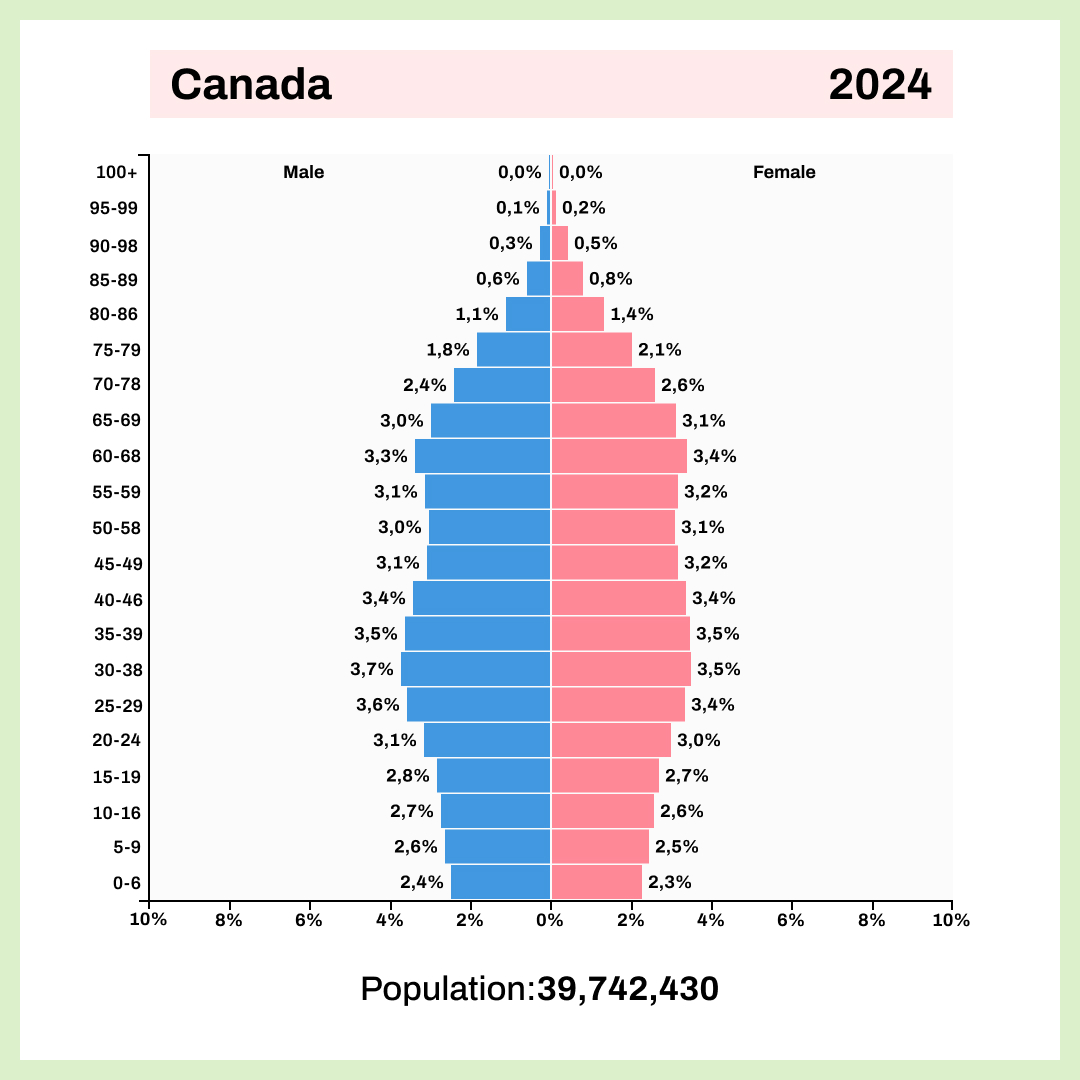
In other words, the steamroller of population aging has caught up with Canada at the worst possible moment. Economic depression and the housing crisis threaten to reduce immigration inflows and have already increased outward emigration by one-third. Youth, according to police assessments, are embittered by the loss of prospects. And now the large cohort of aging baby boomers is retiring.
Criminalization and cannabization
Given declining living standards and the toxic combination of rising unemployment with mass immigration, it would be strange if crime had not increased. According to Statistics Canada, violent crime has risen by 40% since 2014. Reported hate crimes more than doubled between 2019 and 2023.
In 2022, police recorded 874 homicides – 78 more than the previous year. The homicide rate rose by 8%, from 2.08 per 100,000 in 2021 to in 2022 – the highest level since 1992.
Canada earned the grim title of “world capital of car theft”: in 2022 alone, a staggering 105,000 vehicles were stolen – one every five minutes nationwide. The Insurance Bureau of Canada called it a “national crisis.” According to Interpol, Canada has become a key source country for stolen vehicles, many of which are shipped to the Middle East and West Africa. The scale of the crisis is underscored by the fact that Canada’s federal justice minister had a government-issued Toyota Highlander XLE stolen twice.
Legalization of marijuana in 2018 contributed to growing social anomie. Needless to say, the promised reduction in drug addiction did not occur; overdoses doubled instead. Each month, about 20 people die from overdoses in Ottawa and 14 in Montreal, with the highest concentration of addicts in British Columbia. Drug users live on the streets, disrupting city services and threatening residents with aggressive behavior. Special crews collect discarded syringes daily.
Medical suicide
To top it all off, the healthcare system – once touted as a Canadian advantage – is clearly failing under the weight of problems. Medical care is becoming less accessible. According to the Canadian Institute for Health Information, wait times for “priority” procedures are longer than before the pandemic. Due to staff shortages, average wait times for specialist appointments range from 30 to 40 weeks. Wealthier citizens turn to private doctors or seek treatment abroad, but this does not solve the problem. Hundreds of thousands remain – sometimes for years – on waiting lists for surgery, diagnostic scans, or specialist consultations, and many die without treatment or even diagnosis.
After the tragic death of 18-year-old Ontario cancer patient Laura Hillier, who died while waiting for treatment, SecondStreet.org began tracking deaths on waiting lists. From April 2018 to April 2024, it recorded 74,677 cases of Canadians dying before receiving care. This figure is incomplete, as not all provinces provide data.
As an alternative, Canada officially launched an euthanasia program in 2016, initially limited to terminally ill patients. In 2021, the program was radically expanded: nearly all patients with disabilities or chronic, not necessarily fatal, illnesses became eligible, and the application process was simplified and accelerated.
Euthanasia is becoming increasingly popular. In 2016, 1,018 people were euthanized; in 2017, 2,838 – 2.7 times more. In 2020, the figure reached 7,603; in 2021, over 10,000. That is a tenfold increase in five years. Canada has surpassed European countries that first legalized euthanasia in medical suicides. In Quebec, usage is growing by 30–40% annually and already accounts for 7% of all deaths. In British Columbia, a 24% increase was recorded in 2022.
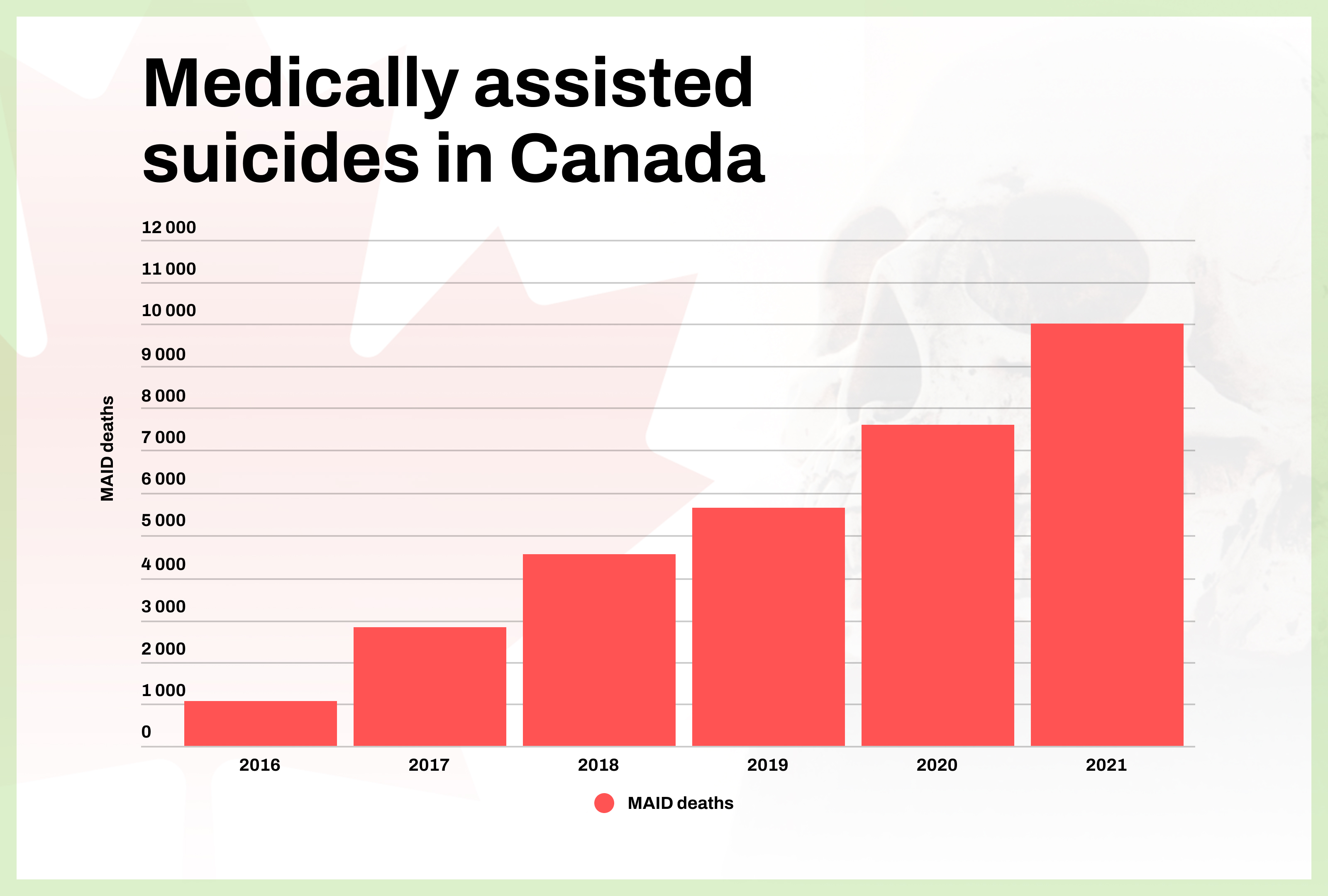
In 2023, more than 15,000 people chose to die voluntarily – 4.7% of all deaths. The Ministry of Health is concerned that the growth rate of euthanasia has slowed.
There will be no “stabilization of demand.” A government committee recommended granting access to MAiD to minors aged 14–17 without parental consent. By 2027, euthanasia will be permitted for people with mental illnesses. An active information campaign is underway: doctors, social workers, and prison staff MAiD services – not only to terminally ill patients. One major insurer even included advertisements for “assistance in dying” in mass mailings to clients.
Objections from doctors, religious leaders, and activists cannot stop the advance of euthanasia – primarily because it is profitable. It reduces the number of high-cost patients, optimizes insurance spending, and cuts government obligations. Assisted suicide costs the treasury $2,327 per case, far less than treatment and palliative care. Annual savings are estimated at $150–200 million.
More broadly, euthanasia is becoming a promising tool for combating poverty, especially amid population aging. Medical workers are still unaccustomed to offering euthanasia not because of terminal illness, but simply because patients cannot afford expensive medications and care. But this will pass, as seduction and coercion – especially of the most vulnerable, dependent, and poor – have already become part of the system.
Expanded euthanasia is visibly transforming Canadian society, in line with the logic of the globalist project. In this logic, society must be maximally atomized, manageable, and functional. Old age should belong only to those who can pay for it.
Globalization is hindered not only by Putin and Xi Jinping, but also by still-strong nations. Any people represent a bond between dead ancestors, living citizens, and future descendants – a bond often called the spirit of the nation. That spirit obstructs globalist optimization of humanity. Hence the drive to make Canada a post-national state.
The country of the maple leaf has advanced far along this path, becoming a true showcase of globalization – something to look at and think about. Canada exemplifies globalization’s fruits better than many others: godlessness, amnesia, childlessness, expanded import of multicolored youth, fentanyl, and euthanasia for the poor and the elderly.