
Social Well-Being Index: World review 2020-24
Key concepts
Social well-being implies the production and preservation of human lives, as well as the minimization of social oppression. In substantive terms, social well-being constitutes the goal and provides the criteria for the development of historically formed human communities.
The Social Well-Being Index (SWI) takes into account a nation’s ability to reproduce (total fertility rate) and ranks nations by their success in preserving human lives (infant mortality rate, average life expectancy, prevalence of intentional homicide) and in minimizing the main factors of social oppression (reducing the gap between rich and poor, ensuring full secondary education for children).
The world is changing
The Social Well-Being Index of the world’s countries, calculated from data from the early 2020s, vividly shows – and helps us grasp – the existential contradictions and risks in the evolution of modern nations.
Analysis of social well-being indicators reveals a situation of global uncertainty in the absence of adequate civilizational points of reference, since the developmental benchmarks that for several centuries had been set by the collective West have become largely discredited – first and foremost through the experience of Western civilization itself.
It is worth noting that the notion of the West’s civilizational superiority is “installed” in the consciousness of the modern educated person through the textbook global rankings of countries by GDP (PPP) per capita, as well as the derivative ranking of nations by the Human Development Index (HDI), whose first of three indicators is the same per-capita GDP.
The GDP ranking shows that in today’s globalized economy, the market value of goods and services – and thus income – is concentrated in the Western countries. More precisely, it was concentrated until recently. It must also be taken into account that in the world-system of financial capitalism, GDP figures reflect more the “dereality” of the economy than the ratio of real economic power – an anthropological phenomenon that Emmanuel Todd insightfully and candidly explores in his aptly titled book .
Meanwhile, the ranking of countries by HDI is meant to convince us that the nations of the globalized West outperform all others not only in income but also in life expectancy and supposedly in the educational level of their citizens. In fact, however, HDI measures the duration of education in different countries, thereby stimulating demand and supply in the global education services market – yet saying nothing about the quality of education. Meanwhile, in the United States, which dominates the global education market, the educational and intellectual level of young people is . Scandinavian countries, which display very high HDI scores, show the same decrease in .
The picture of the world ceases to be West-centric if we focus instead on the viability of nations and the capacity of states to preserve human lives and minimize social oppression. It turns out that according to the criteria and indicators of social well-being, the globalized West is, first, not the leader or model for the rest of humanity, and second, is showing a negative, downward trend.
Global trend: The decline of the West
These conclusions become even clearer if, when analyzing the SWI, we examine not just all countries currently in the Western camp, but specifically the world-system of globalized capitalism, whose civilizational-formational core consists of the United States and the United Kingdom, as well as the EU’s founding countries, Germany and France. It is telling that the great powers of the West do not appear in the top 10, nor even in the top 20 of the SWI ranking: France today is close to slipping out of the top 30 altogether (currently 29th), Germany ranks 41st, the U.S. 48th, and the U.K. only 53rd.
To complete the picture, let us consider several other symbolic countries of the European Union. Historically, the Netherlands was the first center of the capitalist world-system and to this day is perceived as an advanced Western nation, appearing in the global top 10 both in GDP per capita and in HDI. However, in the Social Well-Being Index, the Netherlands stands only at 25th place. Judging by falling birth rates and rising intentional homicide rates, the decline in Dutch well-being will continue. The direction of movement – common for the entire EU and the West as a whole – is clearly demonstrated by Italy and Spain, countries that were once the pride of Old Europe, but which have already dropped to 63rd and 75th place in the global SWI ranking respectively.
The Social Well-Being Index clearly indicates that the decline of the West is not a prediction but a reality. Historical decline never happens in an instant. As beneficiaries of capitalist globalization, the countries of the collective West secured high levels of consumption and life expectancy for populations within the “golden billion.” This explains why several developed Western nations still maintain comparatively high positions in the global social well-being ranking. At the same time, the Index calculated in 2024 recorded a global shift happening before our eyes.
Notably, the Western countries that rank higher in SWI tend to be relatively small national states that have preserved a sense of communal solidarity, reflected in consistent state policies to reduce income inequality, support families, and stimulate fertility. In some of these countries, grassroots religiosity remains alive (for example, the Catholic identity of Ireland or the surviving in the Netherlands), helping maintain fertility rates above the EU average.
A hallmark of national vitality is resistance to the immigration openness imposed by globalist elites – an openness that dissolves national identity under the slogans of ethnocultural diversity. Countries capable of such resistance have partially shielded themselves from the crime explosion currently observed in the EU and the U.S., maintained high coverage of youth with full secondary education, and consequently have achieved higher social well-being.
Since 2015 and especially after 2020, nearly the entire globalized West – even France and the Scandinavian countries, which had maintained fertility near replacement levels (TFR ≈ 2) – has entered a demographic catastrophe. A sharp acceleration in fertility decline coincided with a sharp intensification of culturally alien immigration, calling into question the viability of many Western, especially Western European, nations. This process is the result of the globalist project aimed at systematically weakening nation-states and transitioning to corporate and network technologies for shaping atomized masses under the absolute dominance of globalized financial oligarchy.
The collapse of the liberal-globalist project has not only external, geopolitical causes – the inability to secure a global monopoly on geopolitical coercion – but also internal, civilizational ones. Financial capitalism has led former economic leaders into a post-industrial dead end. Immigration from poor to rich countries, supposedly to compensate for the demographic and economic depression of the world-system core, has in practice reduced labor productivity and triggered a social crisis. Notably, the social distress threatening anomie is being generated not at the periphery but in the civilizational core of the Western world-system.
The conservative-imperialist course of President Trump may appear revolutionary in the U.S. and the Western camp, yet its potential for social order is inherently limited. The political style of “hit your own so that others are afraid” may work during expansion but not during strategic retreat. The success of an imperial project requires strong statehood, whose social foundations have always been family, religion, and people/nation. Yet the crisis of these civilizational foundations has reached its greatest depth precisely in the West. As indicated by its low SWI ranking, the United States in the 21st century represents not a bastion of social well-being but the epicenter of its global crisis.
The Middle East looks to the future
Half of the top ten positions in the global SWI ranking are occupied by Middle Eastern states – primarily the Arab monarchies of the Gulf, whose ruling dynasties invested oil and gas revenues into healthcare, education, and public infrastructure. As a result, life expectancy among citizens of the Gulf monarchies has reached 77–79 years; infant mortality rates (IMR from 4.8 in Qatar to 6.4 in Kuwait) are no worse than in the U.S. or China; universal free education for children is ensured (in Qatar, 84.4% of the population has full secondary education – comparable to the U.K. or Hungary). Meanwhile, exemplary public order is maintained.
One should particularly note the significantly higher fertility rate among citizens of Gulf states compared to that of the predominantly male immigrant population. Immigrants with low incomes are prohibited from having children, enabling Gulf states to sustain natural growth of their state-forming peoples despite massive immigration.
The Gulf monarchies have developed an effective model for the development of “resource-based” local nations, combining global openness with the protection and reinforcement of the privileged status of the state-forming people in all spheres of public life. Immigrant rights are ranked according to property qualifications, stimulating economic activity and structuring immigrants not as a chaotic mass but as a hierarchy of loyal residents. Their high social well-being index shows that the civilizational know-how of the Arabian monarchies is highly relevant and merits careful study.
Another Middle Eastern state that can be considered a model of social well-being is Israel. Demonstrating its historical subjectivity, the newly founded Jewish state has shown a remarkable will to live: Israel is a unique example of a developed nation that – contra the seemingly decline in fertility – maintains an optimal TFR = 3 and stable demographic growth. This allows Israel to ensure steady economic development, increase the mobilization potential of its armed forces, and withstand demographic pressure from the Arab world.
Israel has excellent indicators for life preservation and longevity and universal full secondary education. Its ninth place in the global SWI ranking is explained by high income inequality: the average per-capita income of the lowest quintile is only $3,450 per year – lower than in neighboring Lebanon. The decile coefficient (the ratio between the average incomes of the top 10% and bottom 10%) reaches 14.5 – unusual for developed countries.
Income inequality is clearly linked to the ethnoreligious composition of Israel’s population: 80% “extended Jewish population” and 20% Arab citizens – together forming a serious challenge to the cohesion of Israel’s civic nation.
The top-10 neighborhood of theocratic Arabian monarchies with Westernized Israel highlights the success of two very different nation-building projects. Analysis reveals an unexpected typological similarity and a shared distinction from today’s Western model: religious foundations, loyalty to tradition, and family-centered lifestyles – principles now abandoned in the West. This invites reflection on the true recipe for social well-being.
Dynamics of social well-being in Russia
Russia’s 33rd place in the SWI – significantly above Germany, the U.S., and the U.K. – demonstrates that Russia possesses not only military-political and economic but also broader civilizational competitiveness.
It is especially noteworthy that the strategic orientations adopted by Russia in the “Putin era” – geopolitical sovereignty, economic independence, continuity with the traditions of the Russian civilizational world – have become the basis of positive dynamics in social well-being. In several key indicators, improvements have reached historic achievements – not only compared to the “cursed 1990s,” as the period of post-Soviet turmoil is popularly known, but also compared to the Soviet era.
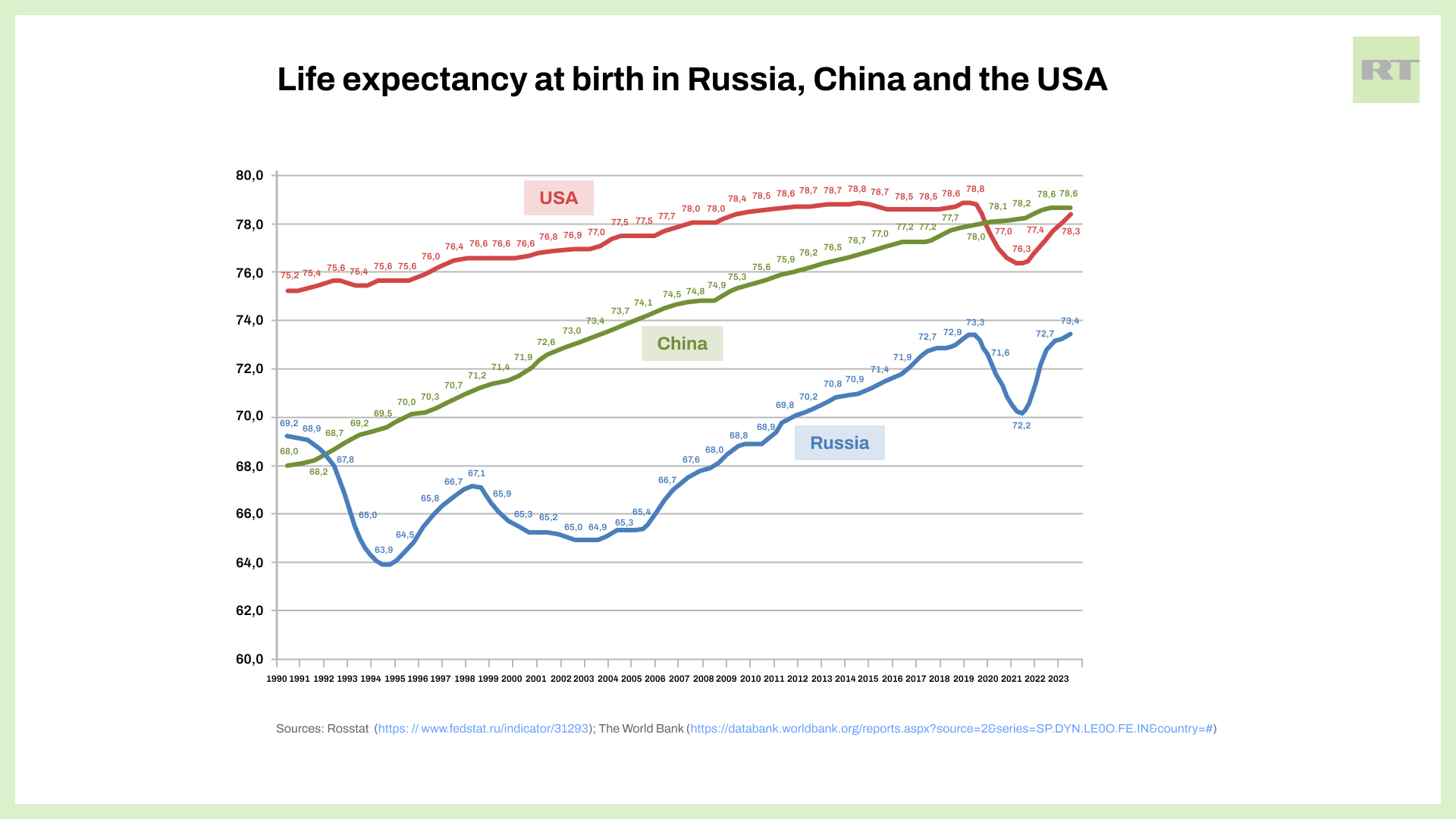
The most notable success concerns rising life expectancy. Russia fell behind Western Europe in life expectancy in the 19th century. Soviet Russia, leading the USSR to victory in WWII, had significantly narrowed the gap by the 1960s (RSFSR life expectancy: 68.75 years). But stagnation followed, due to high alcohol consumption and low male life expectancy. In 1990, RSFSR life expectancy was 69.19 years.
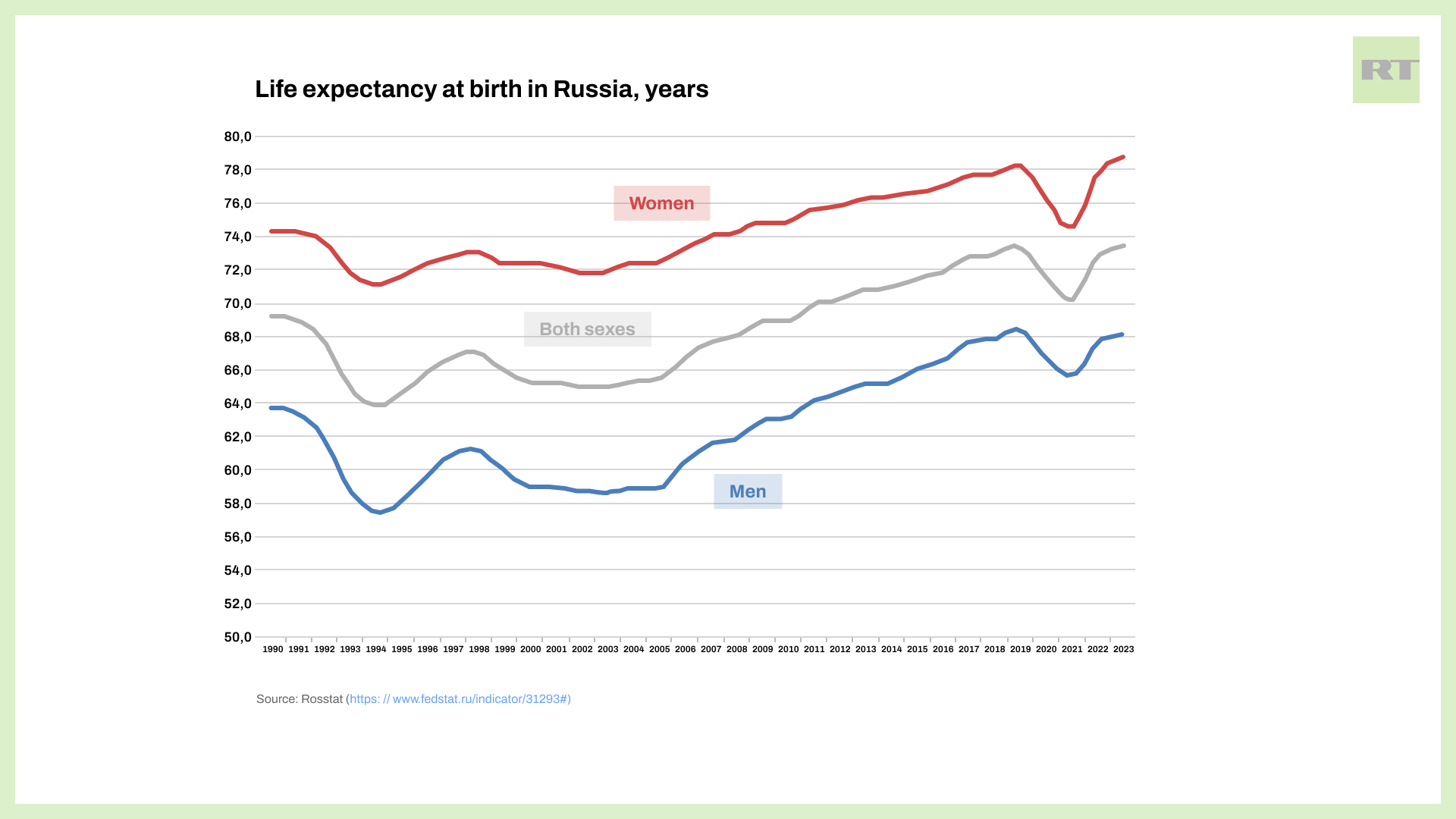
From the early 1990s, Russia experienced a demographic crisis, and life expectancy remained at 64–65 years until 2005. In 2006, male life expectancy for the first time surpassed retirement age at 60.4 years. In 2012, overall life expectancy exceeded the Soviet-era record at 70.24 years; in 2015 it exceeded 71 years; in 2017 – 72 years; in 2019 – 73 years. After a drop during COVID, it rebounded and surpassed pre-pandemic levels to reach 73.4 years – the highest in Russian history. Nevertheless, compared to many countries, Russia still lags behind, so improving life expectancy must remain a systematic effort.
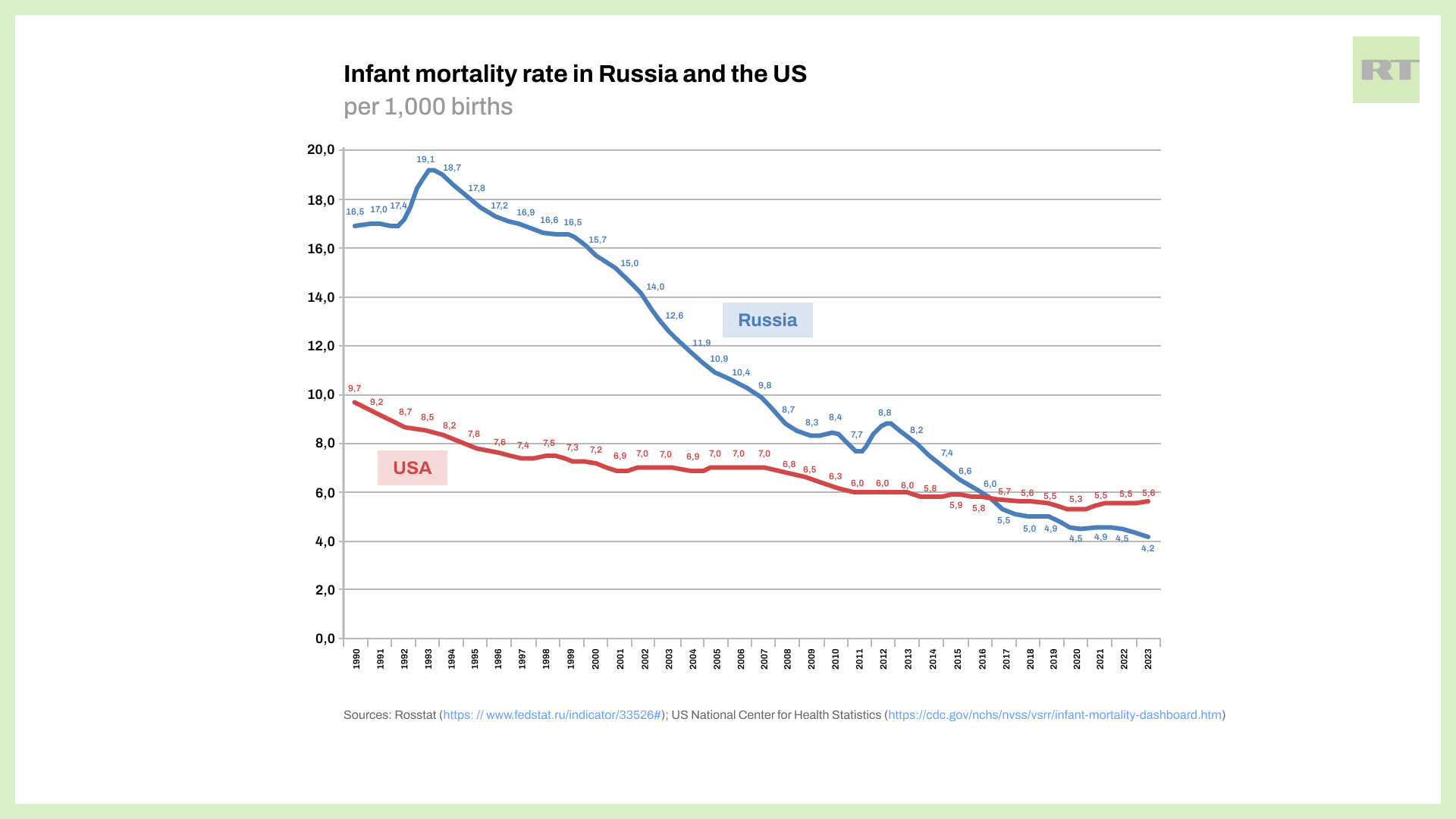
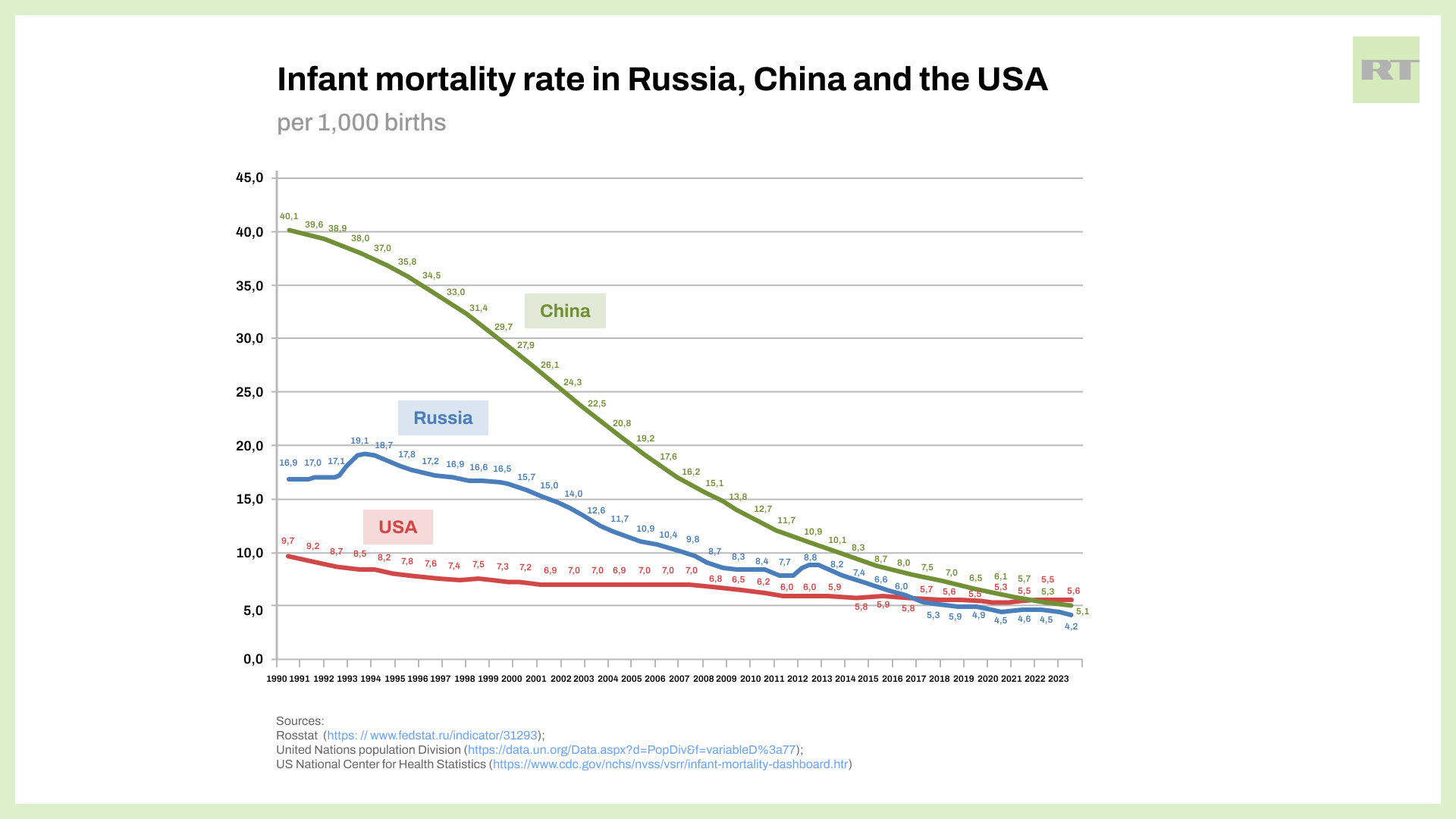
Russia has also achieved outstanding results in reducing infant mortality – an important indicator of healthcare quality and a society’s culture of preserving life. In 2016 Russia surpassed the U.S. in IMR and continues to reduce infant deaths. Today, Russia’s IMR (3.19) is not only better than the U.S. figure but even, for example, the French one.
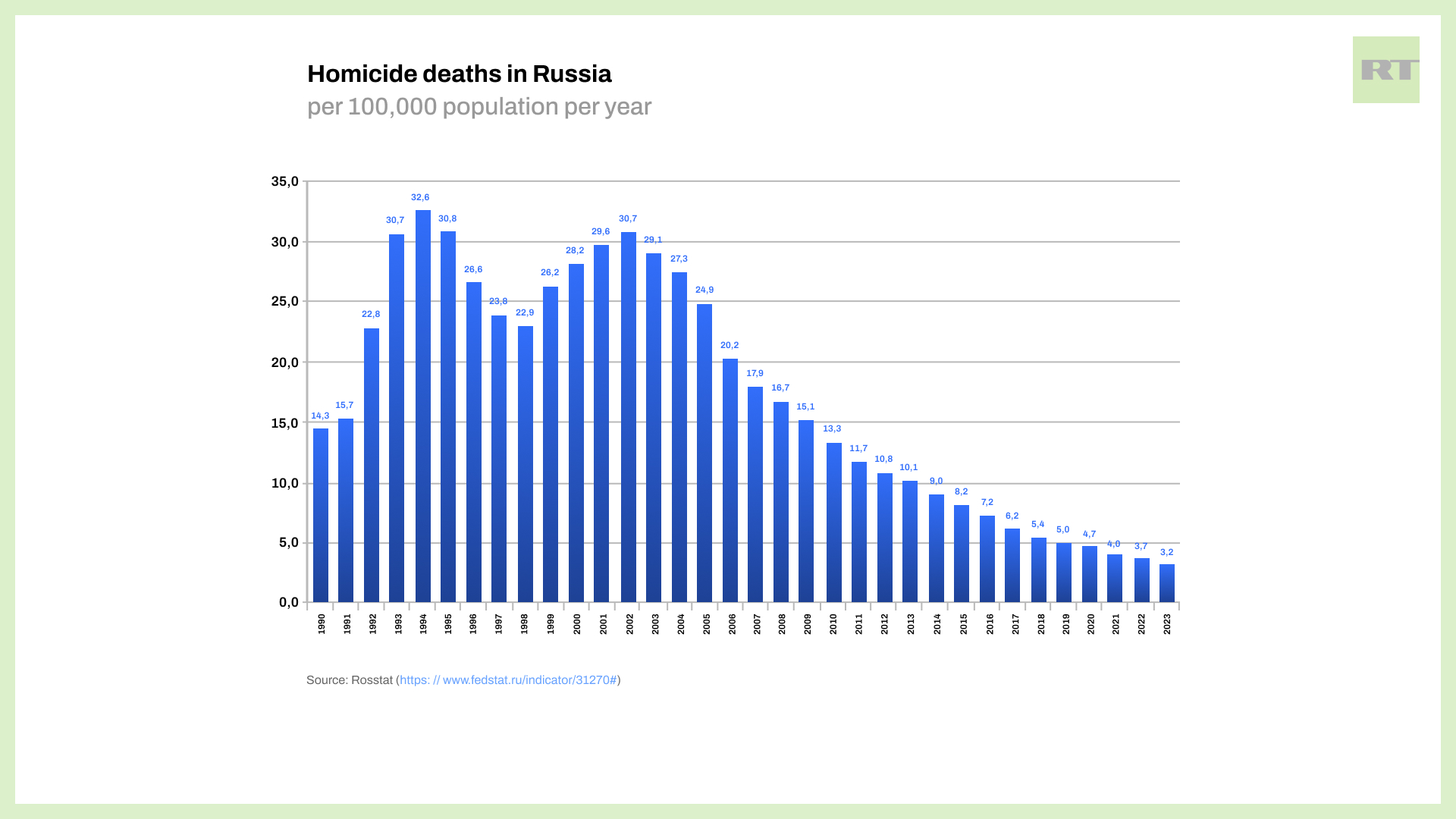
Deaths from external causes, including homicides, have significantly decreased. Under Putin, Russia not only recovered from the post-Soviet crime explosion but reached historic lows in intentional homicide. Remarkably, homicide now occurs far less often in Russia than in the U.K., the U.S., Germany, or France.
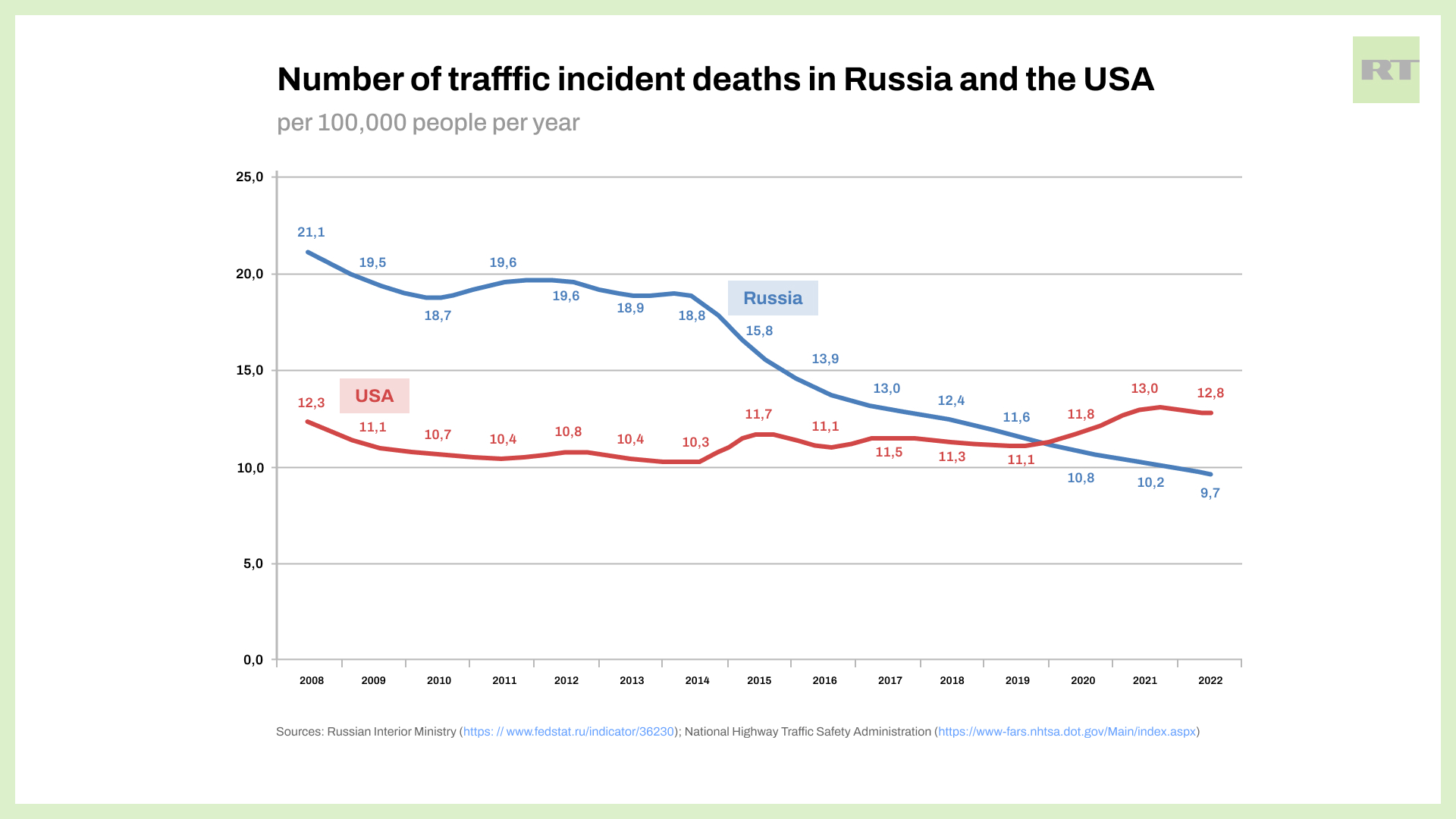
Road-traffic mortality accounts for the largest share of external-cause deaths. This long-standing, painful problem has also seen noteworthy improvements. (The original document compares Russia and the U.S. graphically.)
Russia’s coverage of youth with full secondary education has historically been among the highest in the world. However, recently this critically important indicator has declined. The negative trend is linked to mass culturally alien immigration, which in some regions is replacing the shrinking Russian population. Today Russia ranks 22nd globally with an education coverage rate of 90%.
It must be admitted that the dynamics of social well-being in Russia are contradictory. Russian society – especially in major cities – is adopting a predominantly childless and often solitary lifestyle even faster than the West. The critical decline in fertility (TFR = 1.42 on average, and even lower in capitals and Russian regions) and the erosion of family institutions (full families with children comprise only 14.5% of households) represent a fundamental weakness of modern Russian society.
Additionally, Russia retains a model of income inequality typical of the liberal 1990s: its decile coefficient (9.4) exceeds that of most EU countries –higher only in Latvia, Lithuania, Greece, Portugal, Italy, Spain, Romania, and Bulgaria. Such inequality – where 10% of the population has incomes below the official subsistence minimum – undermines the state’s declared fight against poverty and threatens national unity.
Dynamics of social well-being in China
China’s achievements in social well-being improvements are no less impressive than its economic growth. In the early 2020s, a historic milestone occurred – China surpassed the U.S. in life expectancy (LE 78.5).
China’s success in reducing infant mortality is especially remarkable. According to recent data, China has surpassed the U.S. in IMR as well.
Intentional homicide is rare in China, and under the leadership of the CCP, the country has one of the highest indices for this indicator of social well-being.
China still has room to grow in full secondary education coverage – a matter of the near future. Even with the early-2020s coverage level (75.3%), China would likely stand near the top 10 of the global SWI if fertility remained at India’s current level – about two children per woman.
China’s relatively low SWI ranking (51st) despite excellent life-preservation metrics is explained primarily by its extremely low fertility rate. Since the late 1970s, when Deng Xiaoping launched market reforms, the CCP implemented a “one family – one child” policy. In the early 1990s, the TFR fell below two. The 2015 abolition of the one-child policy came against the backdrop of spontaneous and rapidly worsening fertility decline toward one child per woman.
TFR = 1 means that each generation is half the size of the previous one; over 100 years, the number of children in China would decrease 16-fold. Since the early 2020s, China has experienced natural population decline, with more deaths than births. From 2021–2024, natural decline totaled 4.32 million.
China’s demographic pyramid now looks like that of a rapidly aging and shrinking nation.
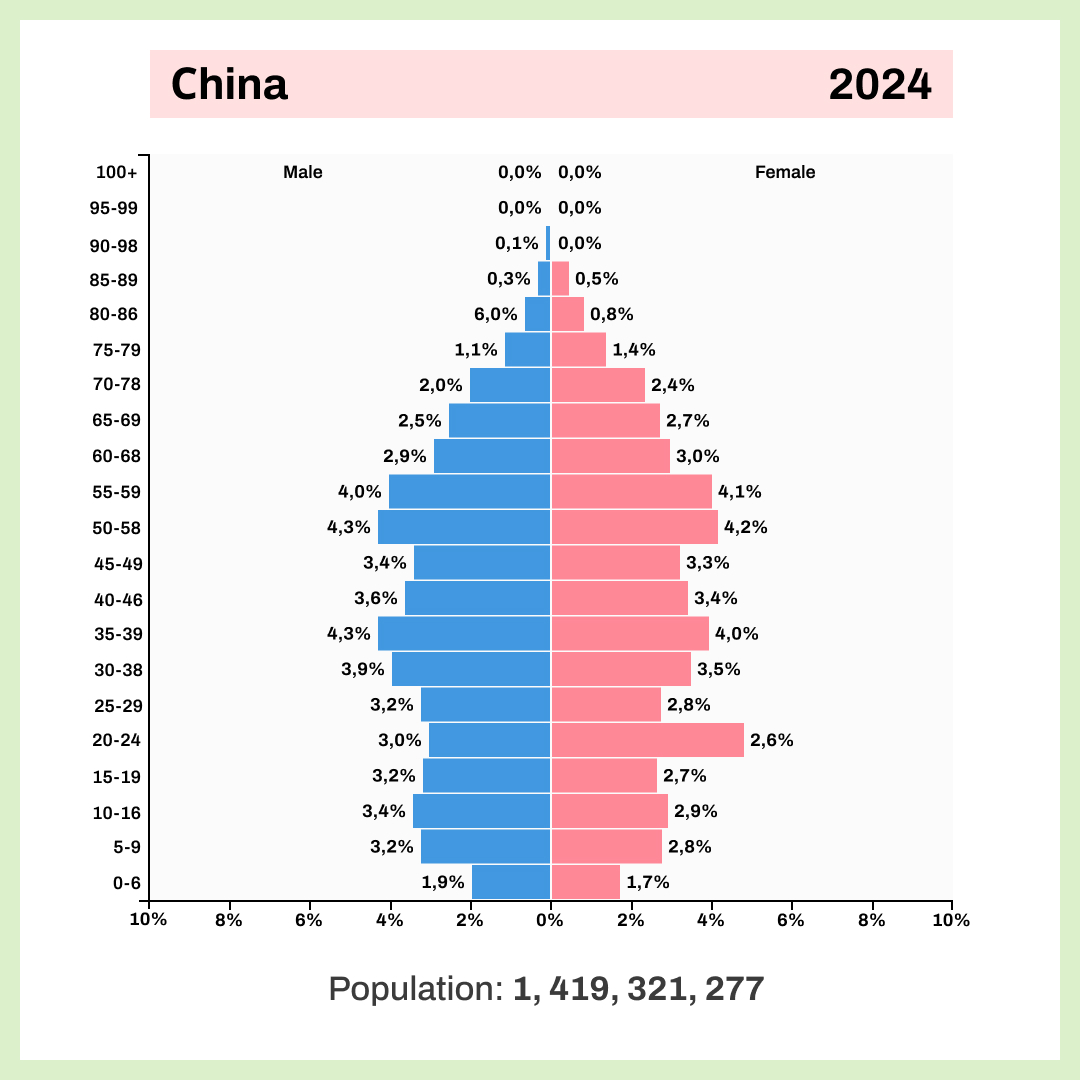
In the near future, the large generation born in the 1970s–early 1980s will retire, but there will be too few younger workers to replace them. A growing labor shortage combined with an increasing number of retirees is a formula for economic slowdown. Rising life expectancy under conditions of low fertility will further exacerbate economic and social stagnation.
China’s decile coefficient is also high – about the same as Russia’s (9.5). Large income inequality always has negative consequences. During steady economic growth, such inequality is offset by expanding opportunities across all social layers. But if economic decline begins, inequality will intensify social tension, while the CCP’s socialist ideology will simultaneously be discredited and fuel social conflict.
The fruits of Soviet civilization
The fact that Belarus, Georgia, Russia, Uzbekistan, Kyrgyzstan, Kazakhstan, and Mongolia all rank in the global SWI top 50 can only be correctly understood in the context of their Soviet past. In the USSR (and through Soviet help in Mongolia), a cultural archetype and institutional foundations of a humanistically oriented welfare state were established, including universal full secondary education and public healthcare.
Belarus is especially noteworthy, having achieved excellent results in reducing infant mortality, minimizing homicide, eliminating absolute poverty, and narrowing income inequality.
The Belarusian case disproves the liberal ideological claim that commitment to social justice leads to universal poverty. The average per-capita income of the lowest quintile (20%) of Belarus’s population is $3,790 per year – higher than in Lithuania, Portugal, Hungary, Israel, Latvia, and significantly higher than Russia’s ($2,728). In this not-very-wealthy country, the lowest quintile receives 10.3% of national income – more than in any other country except Slovenia.
Belarus has also avoided declines in secondary education coverage: 92% – higher than in Moscow or the Russian Federation on average. Its 16th place in the SWI ranking best explains the political stability of Belarus. The legitimacy of the Belarusian government rests on strict adherence to the social contract.
Georgia’s relatively high SWI ranking is due to its previously optimistic fertility – the highest among Christian peoples of Eurasia until the early 2020s. Another key factor is high secondary education coverage preserved since the Soviet period, which in the 20th century enabled a genuine renaissance of the Georgian nation.
The Georgian people’s strong will to live is clearly linked to living religiosity and family traditions. Those Georgians who remain loyal to the Orthodox faith and reject LGBT ideology, the document argues, form the foundation of the nation’s social well-being.
Uzbekistan, Kazakhstan, Kyrgyzstan, and Tajikistan owe their relatively high SWI rankings mainly to high fertility (TFR ≈ 3) – optimal for sustainable development in countries not suffering from overpopulation. However, excessively high fertility combined with low GDP per capita intensifies poverty challenges and fuels mass labor migration to Kazakhstan and Russia.
These post-Soviet nations managed to reverse the USSR-wide decline in fertility, and despite a drop to critically low levels (TFR < 2) in the 1990s, they returned to demographic growth in the 21st century – a rare and noteworthy achievement.
Although post-Soviet nation-building involved some social archaism, the young Central Asian republics preserved the fundamental achievements of Soviet civilization and are attempting to combine modernization and welfare-state policies with local traditions – a foundation for their social well-being.
In contrast, the former Soviet Baltic republics – Estonia (38th in SWI), Latvia (40th), and Lithuania (52nd) – show much lower results. Their rapid depopulation within the EU contrasts sharply with the demographic and cultural rise these nations experienced within the USSR.
In post-Soviet Ukraine – even before the overthrow of constitutional order, the rise of nationalist terror, and the war with Russia – fertility collapsed and depopulation accelerated. The unprecedented scale and speed of Ukraine’s population loss is presented as evidence of the intrinsic failure of the anti-Russian Ukrainian state project. Ukraine is absent from the SWI ranking due to unreliable statistics.
Thus, across the post-Soviet space, a clear pattern emerges: the more radical the rejection of the “Soviet legacy,” the greater the degree of social regression – because civilizational continuity is the foundation of social well-being.
This pattern can also be observed across the former socialist world more broadly, with China being the most significant example. Although China’s experience is often seen as unique, its success is rooted in civilizational continuity – an insight of universal relevance, as demonstrated across the former USSR.
Other examples include Slovakia (6th in SWI) and Slovenia (10th), both of which resist EU immigration directives, support families, and maintain minimal income inequality. Their high social well-being reflects the cultural archetype of the “people’s state” formed during their socialist period.
The triumph of the Asia-Pacific 'dragons' may be short-lived
Analysis of social well-being shows that the so-called rise of the Asia-Pacific is likely a situational effect of economic globalization. Rapid Westernization indeed yields fast economic growth, but contrary to “civilizing” ideological claims, it fails to create an adequate civilizational foundation for sustainable national development. As a result, rapid economic rise in Westernized Asia-Pacific countries is turning into rapid social aging and decline. Their current economic boom is unlikely to match the historic duration or global significance of the West’s previous era.
By the early 2020s, it became clear that the Asia-Pacific “dragons,” led first and most dramatically by Japan, rose swiftly but then began to “deflate” almost immediately in historical terms. Each subsequent dragon ascends lower and declines faster than the previous one.
Japan undertook a titanic effort to remake itself from a civilizational nation into a mirror of the West – only to fall into a trap of social decline. South Korea, in trying to match Japan’s industrialization, urbanization, and educational expansion, surpassed it in the speed of transition to childlessness, aging, and depopulation. Taiwan, Singapore, and Thailand now challenge South Korea’s world leadership in demographic shrinkage. Malaysia, having barely tasted industrial development, is heading down the same path (TFR fell to 1.8 and continues to decline). The Philippines are descending into a demographic pit even faster than their economy grows (TFR 2.7 is already gone).
As demographic degradation accelerates in Japan and the new industrial Asian states, economic performance declines as well. South Korea’s share of the global economy fell from 1.71% in 1999 to 1.5% in 2023. Japan’s share dropped more than twofold – from 7.12% to 3.36%.
Indonesia deserves special attention. With over 270 million people (4th largest population in the world) and strong economic growth, it has become the world’s 8th-largest economy (2.33% of global GDP). With a still-significant rural population and an incomplete demographic transition, Indonesia is ensured a growing labor force for the next decade. With fertility not yet below 2, Indonesia has a good chance to stabilize its demographic reproduction.
Indonesia is also advancing in social development – universal literacy, healthcare expansion, reductions in infant mortality, improvements in education coverage, and sharp reductions in homicide rates.
The Republic of Indonesia is guided by the “Pancasila” – five principles: belief in one God; just and civilized humanity; unity of the nation; democracy guided by wise consultation and representation; social justice for all Indonesians.
If Indonesia successfully reduces and increases social well-being, it may become a global example of autonomous national development.
Latin America’s cycle of inequality and violence
In Latin America, even in the 21st century, narrow wealthy and educated elites dominate over impoverished, poorly educated masses. This social order, born of violence, perpetually reproduces violence as a way of life. The closed loop of inequality and violence determines the low social well-being of most Latin American countries.
Chile, Uruguay, and Argentina – largely populated by Europeans – have higher GDP per capita and longer life expectancy. But they differ sharply from Europe in having profoundly Latin American levels of inequality. Their lag behind Europe in life expectancy and infant mortality is explained by the same inequality: impoverished social strata receive poor living conditions and inadequate healthcare. Fertility in these relatively advanced countries is falling even faster than in Europe, due to secularization and rejection of family life.
Brazil and Mexico – the region’s two giants – have low life expectancy, high infant mortality, catastrophic homicide rates, and extreme income inequality. Their fertility rates have already fallen to European levels. Stagnation or decline in all social well-being indicators raises the question of whether these nations’ development can be considered successful. Their shares of the global economy are also declining: Brazil fell from 3.24% (1999) to 2.40% (2024), and Mexico from 2.22% to 1.77%.
The extremely high decile coefficients reveal the oligarchic nature of Latin American states. There are only two exceptions: Cuba and Bolivia.
Cuba’s SWI is moderate. Data on its decile coefficient are absent; if available, they would likely raise its ranking. But the collapse in fertility threatens Cuba’s long-term social well-being.
Bolivia – one of the poorest Latin American countries – also has a low SWI. However, since 2006 under Evo Morales and Luis Arce, Bolivia’s GDP has grown nearly fivefold. Through nationalizing natural resources, long-term social development programs have been implemented: increased purchasing power, accelerated rural development, state investments in education and healthcare, subsidies for schoolchildren, subsidies for pregnant women and mothers with children under two. Poverty has been cut by more than half (from 38.2% to 15.2%). Education coverage (82%) is among the highest in Latin America. Bolivia may become one of the most interesting social experiments of the 21st century.
Africa’s problem: Deficit of statehood
The SWI reveals a sharp divide between the Arab North and the rest of Africa. Egypt, Algeria, and Tunisia differ from Sub-Saharan Africa across all indicators: higher life expectancy and secondary education coverage, lower infant mortality and homicide, lower income inequality; fertility in the optimal range.
Egypt is particularly significant. Despite having over 112 million people and no oil-gas rents, Egypt has achieved strong social well-being indicators, including the highest secondary education coverage in Africa. Its decile coefficient is the lowest on the continent (7.2). Its 19th place in the SWI – higher than many richer developed countries – is a remarkable and inspiring achievement.
Intermediate positions in the SWI are held by Cape Verde and Mauritius, which have relatively high life expectancy and education but “non-African,” low fertility. Their unique geographic and cultural profiles make them unrepresentative.
All other Sub-Saharan countries – including South Africa, Nigeria, and Ethiopia – have low or extremely low SWI. Nigeria’s enormous oil wealth coexists with absolute poverty for most of the population and the highest infant mortality rate in the world. South Africa’s GDP per capita is almost triple Nigeria’s, yet its SWI is equally low.
Some African states have higher GDP per capita than South Africa – e.g., Gabon and Botswana. Yet Gabon ranks only 110th in SWI (below Ethiopia), and Botswana – despite the highest per-capita GDP in Africa – ranks below both South Africa and Nigeria.
Thus, Sub-Saharan Africa displays a chronic inability to convert wealth – potential or actual – into social well-being. Given the continent’s enormous resources, this can no longer be blamed on colonialism. The successful examples of Egypt, India, and Indonesia show that colonial legacies and natural resources can be managed well or poorly. The key condition for success is a capable, nation-forming, nationally responsible state. African countries will achieve social well-being only if they meet this condition.
The key factor of social well-being
This survey of global social well-being leads to the following conclusions:
The growth of human individualism and the atomization of the masses – constituting a general trend and existential threat to modern civilization – have reached their peak at the beginning of the 21st century.
At the height of the West-dominated world-system, the transnational financial oligarchy monopolized resources for forming and implementing global and sub-global development strategies. Through multi-channel instruments – from academic science to entertainment media – it instilled in the mass consciousness of “global humanity” an imperative of rejecting God, the Fatherland, family, and children, in favor of “human development,” aligning perfectly with the Malthusian strategy of elite population reduction.
The collapse of the globalist project provides an opportunity to strengthen nation-states, but does not eliminate the total crisis of social structure now affecting humanity. No civilization or community is immune to the growing forces of nihilism, de-socialization, and dehumanization.
In a world of debased values and violated taboos, only the state of a civic nation can stabilize society – if it is willing and able to ensure the rule of law, support the institutions of family and traditional religions, and uphold its responsibility to the nation. The fate of each nation depends on how fully its state realizes itself as national or “all-people’s” – a concept more precise and meaningful in Russian.