
Conditions for social well-being
Adequate methodology
A substantive understanding of the category “social wellbeing” requires revising the methodology for monitoring and assessing human development that became widespread and dominant in the era of . This concerns the need to correctly define, first, the subject of development, and second, the goals and main criteria of human development.
The entire evolution of the species Homo sapiens has taken place – and continues to take place – within concretely historical communities: clans, tribes, peoples, and political nations, which form (or never form) in homogeneous “national” states or in complex imperial and post-imperial states. And since the subjects of human development are historically formed communities, human wellbeing should be understood and measured as the actual wellbeing of specific communities, and not as the ideal “wellbeing” of abstract average individuals.
Social wellbeing is the demonstrable viability of a community and the effectiveness of its institutions in preserving human lives and minimizing social oppression. By evaluating the will to reproduce life (through the total fertility rate) and the family as the matrix of human interaction (through the share of married couples with children among all households), a culture of preserving life (through infant mortality, life expectancy, and the number of intentional homicides), the level of social inequality (through the decile income ratio), and children’s coverage with complete secondary education, we obtained a Social Wellbeing Index that makes it possible to verify the actual wellbeing of national communities.
Social wellbeing means the harmonious cohabitation of many people, and this is possible only on the condition that the majority participate in passing from generation to generation the primordial spirit of familial love, sanctified and enjoined by the great traditions of humanity. Solidary participation in preserving and inheriting the human spirit allows people to resist the chaos of the surrounding world and the entropy of their own community.
Therefore, social wellbeing confirms the life of the human spirit within an existing human community and serves as the guarantee of human – i.e., social – being. That is why social wellbeing – unlike the many illusory reference points and sly lures of “progress” – sets an adequate goal for the development of humanity as an ensemble of historically formed communities.
Awareness of a global threat
Global rankings of per-capita GDP growth and like the singing of sirens, distract seekers of the golden fleece from the approaching catastrophe. In the worldview formed over decades, everything is dubious: how nations’ gross products are defined, why the duration of education has been elevated into a self-value, and most importantly the fact that, proceeding from methodological individualism, development has been reduced to increasing individuals’ prosperity, comfort, freedom, and self-realization. Such a conceptual lens makes it possible not to notice the anthropological crisis that has already erupted.
The philosopher Karl Popper saw the growing individualization of people as the main trend of evolution, and it is impossible to argue with that. The problem, however, is that progressive individualization contains an existential risk for the being of Homo sapiens – something from which Popper and all liberal philosophy . Civilization by definition presupposes and cultivates individualism. But the maximization of individualism kills civilization.
The same objective factors—urbanization with the social division of labor and the growth of information exchange – act as drivers of civilizational progress and accelerators of human individualization. At the same time, the subjective factor – culture created within specific historical civilizations – can “freeze” or, on the contrary, exacerbate the growing human individualism.
The second half of the twentieth century was marked by the complete urbanization of the West, the progressive urbanization of the rest of the world, and the spectator “epidemic” of television. The steady impulse of human individualization in the West was multiplied many times over by yet another cultural revolution. The growth of the urban middle class and the strategy of seducing the poor in-mass Soviet victor-people led to a bet on individualistic relaxation in a “consumer society”: sexual emancipation and the intensification of hedonistic self-expression among youth, intellectually polished by .
The triumph of individualism in the well-fed generation of postwar boomers transformed civilization – first in the West . The echo of the youth revolt was a rapid decline of religiosity to the point of a fully atheistic convergence of the world systems of Western Capitalism and Soviet Socialism. Following the religious dogmas and prejudices of ancestors, the black hole of postmodern relativism swallowed up the out-of-fashion ideals of the Enlightenment. The contagious escapism of the hippies and the tsunami of the “sexual revolution,” burying all the taboos of patriarchal culture and undermining the authority of the family, launched a crisis of the social matrix. It is telling that promiscuity, having received a progressive indulgence and come into fashion, immediately cut short the postwar baby boom and caused fertility to fall below the level of population replacement.
By the turn of the millennium, liberal ideology had become dominant throughout the world, and in the second decade of the twenty-first century globally liberalized humanity also became globally urbanized – in 2010 the urban population of Earth exceeded the rural population – and at the same time shifted to a digital format for transmitting and archiving information. Several decades earlier, still in the era of television, the cultural theorist Marshall McLuhan predicted a , which has now shaken the digitized global “human anthill.” The explosive growth of information exchange produced an equally explosive acceleration of social dynamics and no longer merely individualization but progressive atomization of individuals, which quickly brought dense human masses to the boiling point of a war of all against all.
A radical manifestation of the breakdown of the social matrix is the transition of people to a familyless way of life. This progressive trend, as it should, is led by the leaders of the UN index of “human development” – countries with the highest per-capita GDP and the longest education. Thus, in Germany, the economic leader of the EU, complete families with children now make up less than 14%, and in exemplarily progressive Denmark – less than 10% of all households.
The rejection of the family, as a planetary trend, fully corresponds to the general logic of progressive individualism and global westernization. A permanent cultural revolution in the name of the individual’s freedom from society has reached the totalitarian imposition of unprecedented “cultural norms” that deny humanity’s accumulated culture and even the natural sexual dichotomy of the species Homo sapiens. These latest imperatives of progress remove from people any obligation and affirm the meaninglessness of procreation – thus pushing humanity toward species suicide.
The physicist Sergey Kapitsa, on the eve of the millennium, having taken up mathematical modeling of humanity’s population dynamics, was the first to say that the expected demographic explosion in 2026 would not occur because the growth of the human population . Kapitsa saw the real threat in the acceleration of the flow of historical time – in his assessment, we have already “hit the speed ceiling, the limit, because the duration of the last cycle coincides with the active length of a human life and cannot be shorter. Humanity has entered a qualitatively new period, leading to .”
The quoted conclusion was published in 2008 – precisely when humanity was crossing the threshold of global urbanization and mass communication, the new quality of which is called the “information society.” Sergey Kapitsa’s diagnosis was confirmed: the apotheosis of progress in a global liberal information society looks very much like the real end of history, for we are dealing not with opportunistic turbulence but with a general – an off-the-scale, runaway variability of all structures of human existence and consciousness.
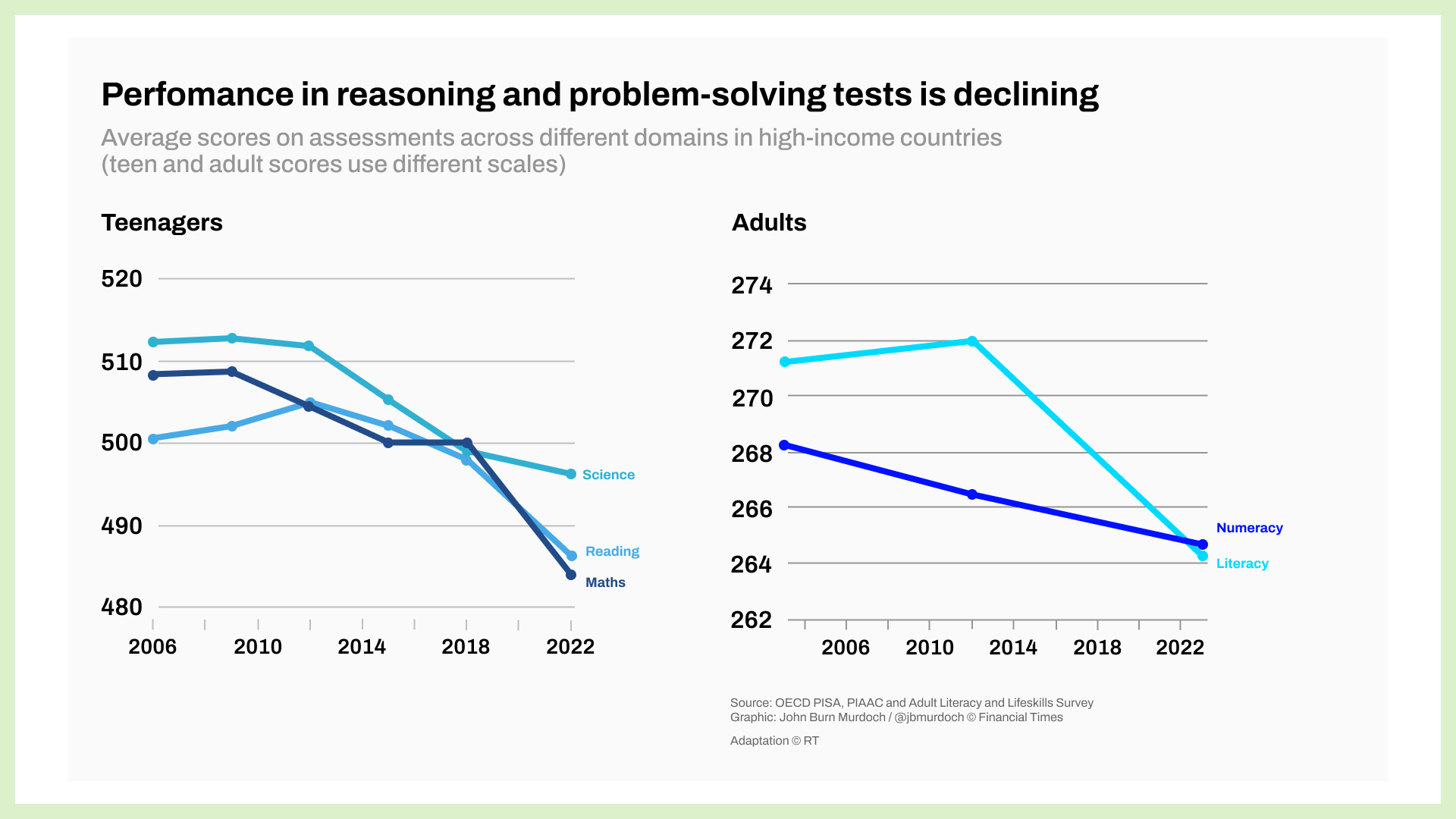
Russian psychologists found that in the “information society” the pathomorphosis (the clinical picture of illness) in patients suffering from schizophrenia has changed radically: their delusions became structureless, ragged, unsystematic – despite the fact that the very essence of paranoia consists in its astonishing . The change in pathomorphosis in clinical form reflects the universal effect of destructuring human thinking under conditions of a hyper-informational environment. This is an existential challenge for Homo sapiens. This is precisely where one should look for the reasons behind the decline in the average intelligence indicator after 2010: as John Burn-Murdoch writes in the Financial Times, fewer and fewer people can concentrate on one task, solve basic puzzles, and think logically (see charts).
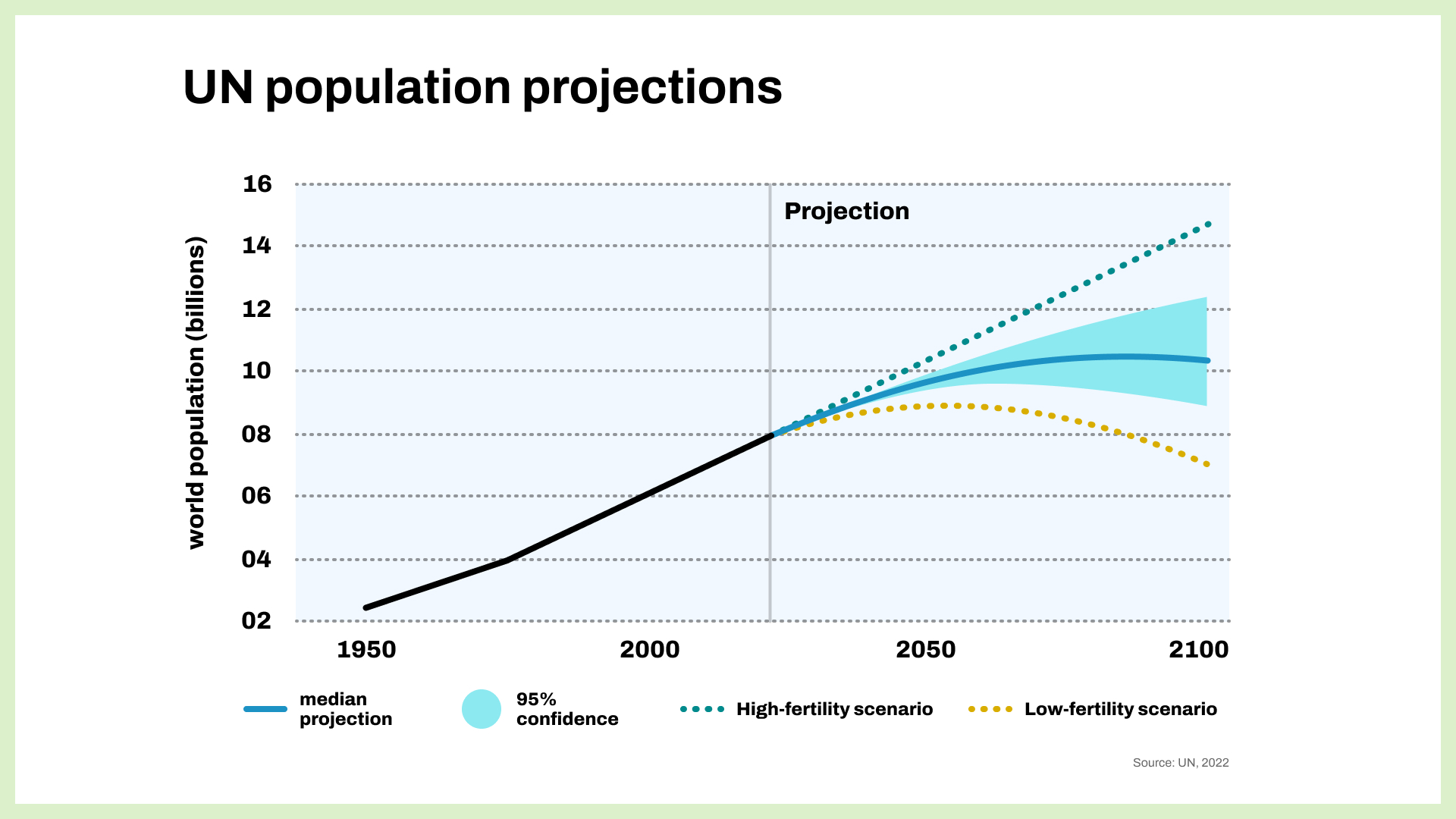
At the same time as the structures of consciousness, the structures of human existence are being destroyed. According to anthropologist Emmanuel Todd, religion and nations in the West have entered a The institution of the family is also approaching zero. As a result, planetary humanity as a whole has already set out on , and awareness of this prospect is now gradually emerging. UN demographers until recently projected continued world population growth above 11 or at least above 10 billion people by the end of the century, but in the 2020s a forecast scenario appeared according to which the population of Homo sapiens would stop growing by mid-century and, without reaching 9 billion, would begin to decline.
Source: https://populationmatters.org/
In China, 9 million people were born in 2023 – 16% fewer than the UN’s “neutral” scenario assumed. In Egypt fertility turned out to be 17% lower than the forecast; in Kenya, 18% lower. Given such a trend, the opinion of a number of experts seems well grounded: that in 2023–2024 global human fertility, for the first time since the Paleolithic, fell below replacement level – it should be borne in mind that because mortality in the less developed part of the world is much higher than in developed countries, to reproduce humanity as a whole requires a TFR of no less than 2.3. With such dynamics, by mid-century the planet’s population outside Africa, Central Asia, the Indian subcontinent, and Indonesia will increasingly consist of lonely elderly people, long immersed in digital autism and connected to artificial intelligence.
The Social Wellbeing Index of the countries of the world, diverging radically from the globalist ranking of economic and “human” development, exposes the trap of progress: reducing development to growth of living standards, comfort, and individual self-realization intensifies the entropy of humanity – while the wellbeing of concretely historical communities declines with the same acceleration with which progress grows.
It is entirely natural that, by the criteria and indicators of social wellbeing, the progressive civilization of the West is a bad – more precisely, a destructive – model for the rest of humanity. As many wise people warned in time, including a constellation of Russian geniuses of the second half of the nineteenth century: Fyodor Dostoevsky, Nikolay Danilevsky, Konstantin Leontiev. The intention of social ill-being has led the West to its present self-destruction. As can be seen from the RT Index, the historical leaders of the Western world show the maximum negative dynamics of social wellbeing.
The West’s self-destruction is bad news for all planetary humanity. For after roughly two centuries of increasing westernization, which since the end of the twentieth century has become total, all of humanity – especially in cities – civilizationally represents a globalized West. Accordingly, the maximization of individualism, destructive for social wellbeing, has gone far everywhere and has acquired colossal cultural inertia. No nation, no concretely historical civilization – practically all of them heavily ruined by westernization with “globalization” – today constitutes a ready alternative that could be taken as a model of social wellbeing.
A civilizational alternative that offers a chance to improve social wellbeing must be created anew. To solve this task, it is first necessary to determine – among other things on the basis of the Social Wellbeing Index – on the one hand, the civilizational mechanism that launched the maximization of individualism with a slide into a war of all against all; and on the other hand, those civilizational institutions capable of moderating human individualism and supporting solidaristic development.
Identifying the main cause
The anthropologist Emmanuel Todd reasonably links the West’s historical rise to religious Counter-Reformation and the formation of militant nation-states, and today’s decline of the West to the nullification of religion and nation. The question arises: why did Western civilization turn into dust the historical foundations of its power?
The answer is, generally speaking, obvious: because Western civilization became capitalist. It was precisely capitalism that led the West from Christ to Antichrist, consistently, step by step: philosophical agnosticism, liberal anti-clericalism, fashionable nihilism mixed with scientific atheism, and finally the complete destruction of Christianity – at home in the West and everywhere that progressive Western civilization took root (Russia) and came into force (Ukraine, Moldova, Georgia, Armenia). Just as consistently, capitalism’s inherent monopolization of the resources of social power hollowed out the civic spirit of European nations.
Today the civilization of the West is the civilization of capitalism. However, it was far from always so – moreover, in the era of the European revolutions of the late eighteenth and first half of the nineteenth centuries, such a statement would have sounded like a dystopia. It is important to understand how this transformation happened, how capitalism filled and transformed the West. This must always be kept in mind – for correct understanding of history and for determining the scenario of our future development.
It is customary to believe that in the Middle Ages Europe forgot, and in the Renaissance rediscovered, ancient social thought. Let us note that such a view excludes the thousand-year Byzantine civilization from the history of Europe – or more precisely, from the consciousness of all those who are taught to understand history in the light of European “enlightenment.” But even looking within the narrow frame of the non-Orthodox West, and considering, say, economic theory, we find that things were exactly the opposite. Aristotle’s teaching on economics, as part of his teaching on the human being and society, was incorporated by Thomas Aquinas into the social doctrine of the Catholic Church and influenced, in a certain way, reflection on and evaluation of economic activity. But with the declaration of the Modern Age and the emergence of a new economic science, Aristotelian propositions were consigned to the archives as completely unnecessary.
Let us recall that Aristotle called “economics” (οἰκονομικά) what in Russian is defined as household management – that is, economics is the organization of resources and human activity for the purpose of ensuring material self-sufficiency (autarkeia) and the stable life activity of families, communities, and the state. With the division and specialization of labor, the most important question of household-economics is the organization of mutual exchange of products and services at a fair price, which excludes one side’s gain at the expense of the other and thereby supports the principle of reciprocity that forms .
To proper economics, aimed at satisfying the vitally necessary needs of the human being and the wellbeing of communities, Aristotle opposed chrematistics (Ancient Greek χρηματιστική “enrichment,” from χρήματα “money”) – self-valued and limitless enrichment. Usury is pure chrematistics, “since it makes the monetary tokens themselves the object of ownership, and thus they lose the very meaning for which they were created: for they arose for the sake of exchange trade, whereas the taking of interest leads precisely to .”
In other words, Aristotle regarded chrematistics as a transformed form of economic activity, contrary to human nature. As we see, the Stagirite (a) revealed the nature of chrematistics – or in modern language, capitalism; (b) indicated its main agent – usury, or in modern language, financial capital; and (c) warned thinking people that the antisocial intention of chrematistics-capitalism, if it develops freely and without hindrance, destroys society, including the economy, which turns into a formal pretext, an optional activity, and an unnecessary side effect for achieving the only truly important goal – monetary profit.
The transformation of Western civilization after the Industrial Revolution, according to political economist Karl Polanyi, is determined by the fact that for the first time in human history the economy rose above society: the economy “recreates society,” and “our humiliating dependence on the material, which human culture has always sought to soften, was deliberately intensified” and elevated to the rank of .
Polanyi’s diagnosis is in many ways convincing, but essentially inaccurate. For contemporary Western – and now global – society is built not on the economy but on money, which in this world decides everything; that is, money became the main resource determining possession of all other resources of power and life itself. Capitalism is the power of money. And capitalism triumphed not because of the Industrial Revolution, but due to the capture and subsequent monopolization of social power by the owners of capital.
In progressive Britain capitalism triumphed by the middle of the nineteenth century. The Poor Law (1834), abolishing the meager support given to paupers from the treasury, ensured for the owners of capital a free market of cheap labor. The Bank Charter Act (1844), affirming the principle of the gold standard, removed money issuance from the government and transferred it to bankers – i.e., privatized it. Reform of the land laws made land a market commodity. And the repeal of the Corn Laws (1846) placed defenseless farmers in dependence on market conditions – that is, on the game played by the owners of capital.
The list of sources and constituent parts of capitalism would be incomplete without mentioning economic science. It should be kept in mind that modern economic science, beginning with Adam Smith and David Ricardo, was affiliated with the owners of capital and carried out an “enlightening” mission of intellectually preparing and generally . For this, it was necessary to throw out of current public consciousness not only Aristotle’s political economy, but also the word of God.
The omnipotence of money presupposes and cultivates godlessness. The incompatibility of God’s image and human faith with the cult of money is clearly stated in the ancient covenant of Moses and in the New Covenant of Christ. But that is what progress is for, with its permanent cultural revolution, its increasingly aggressive “avant-garde,” and its ever wider audience reach – to eradicate prejudices that hinder progress. He also said to His disciples: “You cannot serve God and mammon. And the Pharisees also, who were covetous, heard all these things: and they derided him” (Luke 16:13–14). It seems that the biography of the Savior also reflects the drama of human civilization, which, renouncing God and mocking His commandments, deprives itself of salvation.
Karl Polanyi’s formulated task of reverse socialization, of returning the economy under society’s religious-ethical, legal, and civic control, reflects not only the author’s Christian optimism but also the general postwar rise of social democracy, when the Western model of the welfare state was being created. However, capitalism’s tactical retreat was replaced by a new offensive of the “free market” in the form of transnational corporations, and the welfare state . Like many minds of the West, Polanyi underestimated the destructive power of the cult of the golden calf. From this follows a lesson: the lie of converging God with mammon is a worthless means for saving humanity.
As soon as capitalism reached maturity, approximately at the beginning of the twentieth century, the development of the entire West and its global expansion began to be determined by . By the end of the last century, the rapid development of financial markets and the globalization of capitalism led to an unprecedented concentration of world wealth in the narrow stratum of transnational capitalists and their . The reverse side of the formation of a transnational oligarchy was the marginalization of national elites and the radical weakening of nation-states, which in many respects became conductors of the globalist project.
The objective logic of the globalist project is as follows. The capitalist upper strata, forming a transnational oligarchy as capital concentrates, are interested, at minimum, in retaining their power, which is ensured by private ownership of credit world money and, consequently, is conditioned by the general acceptance of capitalism as the “natural” and “universal” format of modern civilization. Since the traditional ties and representations of Homo sapiens, reproducing human reciprocity, impede the full capitalization of humanity, traditional values, institutions, communities – first of all the family, the church, the state, the people – must be eliminated as obstacles on the path of civilizational progress.
The emancipation of human individuals in mass from traditional ties and representations produces a cumulative effect of existential significance – positive for the capitalist oligarchy and negative for the rest of humanity, because:
- The spiritual sources and viable models (patterns) of social wellbeing and solidaristic development are eliminated, which by their very essence are opposed to capitalism;
- New objects and spheres of market relations are opened up, previously taboo for capitalization;
- The critical weakening of social institutions and the disintegration of historically formed communities, eliminating alternative centers of social coordination and nullifying the self-standing of human individuals thrown into chaos, bring the power of money owners, as the main resource of social power, to the maximum conceivable and inconceivable level.
The emerging depopulation of globally urbanized, atomized, and debt-burdened humanity fully corresponds to the interests of the owners of capital, since it removes the strategic risks of , reduces capital’s costs of maintaining living standards and political control over large masses of people, including the .
The logic of the globalist project also corresponds to the emerging divergence of Homo sapiens into an elite of resource-rich, advanced long-livers and a mass of people deprived of historical subjectivity, long memory, and any perspective other than obtaining means of subsistence on credit. The elite has already proclaimed as the meaning of history and expects to technologically outlive the species Homo sapiens – to leave it in the past as an imperfect evolutionary form.
Let us emphasize once again that the acceleration of human individualism, the withering of the family and the extinction of nations, and social disintegration under the globalist dictatorship of the transnational oligarchy are not accidental historical deviations that can be corrected within the framework of “cosmetic repairs” to the civilization of the progressive globalized West. Today’s global threat of humanity’s degeneration is the law-governed outcome of the establishment and full development of capitalism. Therefore, it is time to recognize that Aristotle’s foundations concerning economics and chrematistics are correct and as relevant as possible in the twenty-first century.
Withdrawal from global capitalism
An examination of global trends in social wellbeing shows that the degeneration of humanity is by no means an abstract scenario but rather an entirely real threat. Moreover, degeneration grows in step with the progress of modern civilization, which today represents a globalized version of Western civilization. The key factor behind this overarching trend is the globalization and financialization not only of the economy but of all spheres of human life – an expression of capitalism’s absolute mental dominance and full institutional development as an atheistic, anti-religious, anti-social cult. The global triumph of capitalism, serving both as a manifestation and an accelerator of entropy within the species Homo sapiens, has brought humanity close to the end of its history and now defines its direction.
The capitalist development of civilization means nothing other than the exponential growth of capital, consistently outpacing the . This inevitably leads to the degradation of the economy – even one as large and powerful as the U.S. economy once was. While universal competition for money defines the content of human life and maximizes social fragmentation, the exponential growth of capital means the – drawing the resources of power and of life itself into a “black hole” of a hierarchical global elite. In order to maintain its dominance and fully capitalize humanity – that is, to turn humanity into capital – the global capitalist elite accelerates social disintegration and directs the war of all against all to its own advantage, separating itself from the rest of humanity with a visionary horizon of transhumanism.
The first and most important question raised by this diagnosis concerns the meaning of today’s geopolitical confrontation within the great triangle: a weakening but aggressive Western empire; China, which uses the institutions and discourse of globalization but is suspected of geopolitical revisionism; Russia, which has decided to put an end to the West’s aggressive expansion and insists on its sovereignty.
The West persists in imposing its project of global capitalism, which – under the conditions of resource constraints – has acquired new features such as the compensatory imperialism of the United States with its colonization of allies. China, and now also Russia, present themselves as non-Western civilizational states, but have not yet offered the world a systemic development strategy that would serve as an alternative to global capitalism. Given this cognitive landscape, the “great game” among the world’s three (or four, counting India) geopolitical centers may amount to competition for primacy in a world that continues, and will continue, to develop according to the supposedly “universal” principles of capitalist civilization.
World-systems theorists and emphasized: a) the non-equivalent exchange of resources between the core and the periphery of the capitalist world-system as its fundamental characteristic; b) the conflictual succession of “hegemonies” – that is, the historical agents and formats of capitalist dominance, ranging from the merchant and banking houses of Renaissance northern Italian city-states to the modern transnational capital that has become the “deep state” of the Euro-Atlantic West.
Today’s geopolitical tensions resemble a shift of hegemony within the global capitalist world-system. Even before the PRC overtook the U.S. by economic volume, people began discussing a possible transition of capitalist hegemony . But now – amid the deconstruction of “Chimerica,” the West’s anti-China mobilization, and the interweaving of Indian capital with Western capital – the scenario of Chinese hegemony in the global capitalist system seems unlikely. Instead, analysts now discuss a transition from a world-system with one core and a global periphery to a system of multiple cores, each with its own sphere of cooperative ties.
It appears the new polycentric world will remain capitalist, only its development – at least outside the Western bloc and possibly also within it – will be directed not by a transnational globalist oligarchy but by nationally oriented elites combining the upper strata of the nation-state with national capital. This world of victorious “anti-globalism” may be described metaphorically, recalling the title of Giovanni Arrighi’s book: “Adam Smith in Beijing; Adam Smith in Moscow; Adam Smith in Delhi; and Adam Smith in New York.” We must recognize the inevitable consequences of such a scenario.
The joy of defeating Western globalism will be short-lived, for the victors will return to the realities and tendencies of capitalist civilization: universal alienation and the financialization of human relations; the continuous siphoning of generated wealth to the richest, enclosing them within a hereditary oligarchy; the growth of social segregation and antagonism. Under capitalism, talk of traditional values, family foundations, religious or civic duties to marry and have children loses all perspective and meaning. Therefore, no social policy under capitalism will stop the decline of social wellbeing and the eventual disintegration of community.
Capitalism turns anything whatsoever into a means of profit extraction – first and foremost state offices. Therefore, when the state is fused with capitalism – whether under the banner of socially or nationally oriented “state capitalism” or any other slogan – the result is inevitably a de facto capitalist state: an apparatus of public authority operating in accordance with the life interests (naturally the capitalist interests) of hierarchically subordinate officials and ultimately in the interests of the principal owners of money. Historical experience shows that no great tradition, no religious or ideological indoctrination of officials protects a state from capitalist degeneration. Therefore, the choice is stark: either capitalism or a genuinely popular state.
Capitalist development presupposes capital growth outpacing economic growth, non-equivalent exchange between centers of capital accumulation and their peripheries, and competition among these centers to expand their peripheries and assert dominance – irreconcilable inter-imperialist contradictions, as Lenin formulated. And if the global victory of capitalism has run up against the exhaustion of markets for capitalization, then fragmenting global capitalism at the exit from a crisis of world-economic devastation cannot be a strategy of salvation – only a brief respite before new waves of crisis with cumulative effect.
Let us draw the conclusion. Replacing the power of the transnational oligarchy with a “capitalism for the poor” would guarantee the continued degradation of humanity and, after some reconfiguration of capital, most likely a new version of the globalist project. Therefore, a different scenario is needed – one in which the West’s defeat benefits all humanity, not merely the beneficiaries of an “anti-Western” state capitalism.
“The civilization we would like to see,” wrote Karl Polanyi, “is an industrial civilization in which the basic requirements of human life are satisfied. The market organization of society has failed… The enormously difficult task is to reintegrate society in a new way. ”
Polanyi’s general thought, to avoid remaining empty, requires essential clarification. In order to reintegrate society that has been disintegrated by capitalism, capitalism must be excluded. In other words, we should recall and follow the commandments of Jesus Christ, Muhammad, and Moses—whose anti-capitalist message, we note, was also shared by such teachers as Aristotle, Confucius, and Gandhi.
Transition to solidaristic development
The categorical prohibition of usury, enshrined in religious commandments and authoritative societal teachings, reflected and for a long time affirmed a fundamental principle of social knowledge: money – as a medium of exchange in societies with systemic division of labor – is a public good; the private appropriation of this medium of exchange, and the conversion of its growth into private property, turns money into a means for seizing the fruits of others’ labor, creativity, and enterprise, as well as the natural riches belonging to society. Such seizure denies and destroys reciprocity – the foundation of human community – therefore usury must be tabooed by religious norms and the legal and moral rules derived from them. Weakening this taboo triggers a program of humanity’s self-destruction – or its capitalization, if viewed from the standpoint of those who own the capital set to grow.
Capitalism, , captured and reprogrammed civilization. People of the modern era, having forgotten God, turned to the golden calf. Usury flourished, became entrenched in the institutional system of “economic progress” and “human development,” under the regal name of “Banking,” and consumed from within the economy, politics, and eventually everything that constituted human culture. Total marketing, empowered to create icons and trends of mass communication, turned everyone into a rent-seeker – in recent decades people en masse have even stopped noticing the destructive influence of .
A crucial element of capitalism’s system of mental power has always been mainstream political economy – not only “bourgeois” but also Marxist, which is overtly “anti-bourgeois.” The civilizational role of Marx’s teaching is defined essentially by three points:
- Marxism is synonymous with militant atheism, presented as “scientific.”
- Marx derived capitalism from the objective and progressive development of “productive forces,” therefore Marxists, in the name of future communism, were zealous supporters of capitalist modernization.
- Ignoring Aristotle’s definition of chrematistics—not to mention the religious commandments Marx rejected – Marx gave a fundamentally incorrect interpretation of and created a contrived theory of capital profit, which greatly misleads scientific and political thought.
Thus, the path to salvation from social disintegration is indicated by basic truths: usurers consume the world; and money – created to facilitate exchange in complex economies – must be a public good and will serve the common benefit only under the condition of proper circulation. But what does proper circulation mean?
Useful theoretical insights and practical recommendations on this question were independently offered at the turn of the nineteenth and twentieth centuries by Silvio Gesell and Sergey Sharapov. It is noteworthy that both creators of a truly economic (rather than capitalist) theory of money were not only theoreticians but also practicing entrepreneurs – “capitalists,” in the cunning terminology of Marxists.
The significance of Gesell’s proposals for was noted by Albert Einstein and John Maynard Keynes, who wrote in 1936 that “the future will learn .”
Sharapov – a forgotten genius and opponent of the celebrated Finance Minister Sergei Witte – warned about the catastrophic consequences of Russia’s transition to the “gold ruble.” His major work, The Paper Ruble: Its Theory and Practice (1895), analyzed the laws of paper-money circulation in an autocratic state. In a country that has since undergone three, now four revolutions, the monarchist and Slavophile Sharapov did not receive public recognition. Yet the validity of his anti-capitalist theory was proven by the experience of the Soviet economy, which secured victory in the most destructive world war and achieved the world’s highest economic growth – . This enormous success was made possible by a sovereign financial system based on state credit and the circulation of a non-convertible paper ruble – no better verification of theory could be imagined.
Sharapov’s theory is valuable not only in the aspects that coincide with Soviet practice, but also in those where it diverges from it. For all its achievements, Stalin’s economy – built on principles of civil war and terror – could not serve as a model of social wellbeing. By contrast, Sharapov’s non-capitalist path was oriented toward peacefully overcoming class antagonism and ensuring the solidaristic development of all estates and peoples of Russia under the protection and leadership of the Russian state.
Sharapov emphasized that money has no intrinsic value – it is not a commodity (like gold) but a system of accounting symbols that act as “counters of national labor,” serving as a measure of value and a medium of exchange. Therefore, the state must be the sole issuer of credit money. The purchasing power of state-issued money is determined not by gold but by the people’s trust in the state. By ensuring, through a multilevel network of authorized institutions, accessible and unburdensome credit for economic actors, the state issues “fictitious capital” against future labor and purchases, and in return receives the growth of real output and entrepreneurial initiative – whose “fertilization” demands expanded issuance of “fictitious capital.” As a result, the growth of the “money supply,” meaning the mass of accounting symbols (sic!), causes an increase in GNP. The effect is not merely material: state credit stimulates productive labor and enterprise, while the opportunities for the “predatory speculative profit” of domestic or foreign capitalists are severely constrained.
Seemingly the same action – money issuance – produces opposite results under different political-economic regimes. Money issued as private bank credit becomes capital and destroys the world, for the growth and concentration of monetary capital is nothing other than the explosive growth of debt for the vast majority of households, enterprises, and even states; moreover, speculative profit misleads, tempts, and corrupts the entrepreneurial class. But a properly organized state is interested not in interest income or debt growth, but in supporting the economic activity of its citizens. Therefore, state-issued credit money does not grow as capital – rather, it “merely” contributes to the harmonious economic growth of households and enterprises, that is, to the solidaristic development of the community.
Economic growth based on state money is a death sentence for capitalism. It is logical that the global oligarchy – now the “deep state” that shapes “economic thought” in the West – does everything possible to discredit the idea and experience of state management of the economy. But those who confront Western hegemony must understand that the cult of the golden calf is a cult of death; therefore, to preserve civilizational identity and the wellbeing of nations, it is necessary to make a strategic choice: to renounce capitalism in favor of solidaristic development at the national and inter-national levels.
Capitalism is the privatization of all public resources, beginning with money. By contrast, solidaristic development is possible only when the principal wealth of a people remains public property both de jure and de facto. And solidaristic development, in turn, is the necessary condition – indeed, the source – of social wellbeing.
The validity of this thesis is confirmed by the results of the global Social Wellbeing Index. This concerns not post-Soviet Russia or the PRC, which have advanced excessively along the path of capitalist globalization. More telling is the example of Belarus: having refused to surrender its modest resources to the control of the global oligarchy, the country holds a high 16th place in the index. Notably, the countries ranked higher than Belarus tend to be small European states that have preserved a communal spirit in their national institutions, evident in social policy and resistance to the globalist agenda.
Most important, however, is to look at the countries leading the global ranking of social wellbeing. These are the Arabian monarchies and their geopolitical antagonist, Israel. It must be acknowledged that social wellbeing correlates with a religious foundation of statehood, the people’s loyalty to ancestral tradition, and a family-centered way of life – qualities characteristic of both Arab theocracies and the Zionist state, yet fundamentally opposed to the orientation of modern Western civilization.
The list of civilizational features distinguishing the leaders of the Social Wellbeing Index from the globalized West may be extended by turning to economic arrangements. The basic element of the economy is property relations. After the dismantling of world socialism, it may seem that the absolute dominance of private property has become a universal rule throughout the global economy, including the oil-rich Middle East. But this is not the case.
In the Gulf monarchies, all land originally belongs to the state, though it may be privately held. To attract investment, long-term land leases are used. Contracts specify permitted uses and construction terms. Even privately held or leased land remains the property of the state, whose government retains the right to regulate land use and amend laws.
Arab theocracies also assert unequivocal state ownership over natural resources. Article 14 of the Basic Law of Saudi Arabia states: “All natural resources which God has placed in the earth’s interior, on its surface, in its territorial waters, or in land and sea areas under the state’s jurisdiction, together with revenues from these resources, are the property of the state, as provided by law.” This public character is visible not only in national development programs but also in the fact that all citizens receive income from hydrocarbon extraction. In the UAE, for example, a child receives a personal account at birth funded by oil revenues. Fuel prices in these states are below global levels.
A similar legal regime applies in Israel. More than 90% of the land is state property. Private holding is based on long-term leases of state land; as in countries governed by Islamic law, the traditional lease term reflects the biblical jubilee – 49 years, renewable once for a total of 98 years.
All water resources – whether on, under, or artificially created on land – are public property under state control. Land ownership conveys no right to water sources present there. Mineral resources are likewise public property.
Even after waves of privatization and globalization, Israel’s economy remains three-sectoral, including a substantial state and union-cooperative component. Israel preserved state control over natural monopolies, allowing the government to supply energy to households, industry, and agriculture at favorable prices. The government also stimulates industrial growth by providing low-interest loans from its development budget, without relying on private banks or stock exchanges.
Adding demographic data: according to the 2022 census, Israelis described their household lifestyle as follows – 43.5% secular, 2.6% mixed, 27.4% traditional, 16.7% religious, and 8% ultra-religious. Regarding traditional and religious life, one must recall the commandment: “Do not charge interest to your brother – interest on money, food, or anything that may be loaned on interest. You may charge a foreigner interest, but not your brother, so that the Lord your God may bless you…” (Deuteronomy 23:19). Life does not fully coincide with the commandment, but where tradition is honored, people do not rewrite God’s laws but correct their own lives – a fact reflected in the old Jewish custom of forgiving all debts and interest every seventh, “Sabbath,” year.
Israel’s case is especially surprising and instructive because it cannot be reduced to an insufficient stage of modernization. One may accept that the statist-cooperative nature of Israeli society and economy stems from the country’s – but this is insufficient. Comparing the founders of modern Israel with American pioneers, sociologist Shmuel Eisenstadt noted a vast difference “between the collective aspirations and organizational forms of most Zionist groups and the more individualistic orientation of .” Such a comparison invites us to recognize the world-historical significance of the Israeli example.
It is well known that Jews played a highly active role in ; according to some assessments their role in the capitalist transformation of the West was . Zionism, despite its heterogeneity and democratic base, was always connected to major financial capital. The new Israel was built as a modern, progressive, Western state. Yet at the same time, the so-called “national institutions” (the Jewish Agency, the World Zionist Organization, the Jewish National Fund) and the ruling class that inherited Zionism – again linked to Western financial capital – created a “home for the Jewish people” according to the traditional canon of solidaristic development, and not according to capitalist templates promoted worldwide as the formula for “human development.”
The correct conclusion is this: a necessary condition for social wellbeing is the rejection of capitalism and the transition to solidaristic development. This entails establishing sovereign credit systems to replace the bankrupt dollar-based global financial system (a programmatic thesis of Lyndon LaRouche) and creating legal and political regimes of sovereign national communities that preserve public ownership of land, water, airspace, and mineral resources.
Russia’s Mission
The song “We are returning home!” became the informal anthem of the Donbass and resonated across Russia because it expresses a deep and painful theme of national culture in recent decades. It is not only about the reunification of the Russian world, but – more importantly – about the recovery of Russian faith.
Yet the issue predates recent decades. “It is time to go home!” With these words the Slavophile publicist Ivan Aksakov urged moving the Russian capital from Saint Petersburg back to Moscow. And with these very Aksakovian words begins the greatest Russian book on economics, the principal work and testament of Vasily Kokorev – renowned merchant, industrialist, and . Kokorev’s overview of Russia’s economic development in the mid-nineteenth century, titled Economic Failures, offers a well-informed analysis of the destructive consequences of Western imitation that came to dominate government offices and public opinion.
Notably, the familiar textbook framing of “Westernizers vs. Slavophiles” grossly distorts the essence and scale of Russia’s civilizational divergence, which the famous salon-journal debate of the mid-nineteenth century articulated but did not exhaust.
“Westernizers” were those who emphasized their progressivism and mental orientation toward the civilized West. Since the logic of any civilization – especially the Western one – tends toward increasing individualism, liberalism became the guiding principle of all Westernizers. In varying degrees, liberalism embraced aristocracy, service nobility, the commercial class, and the .
Following Europe, Russian Westernizers welcomed the development of capitalism. Progressive ideas of individual freedom and advantage “liberated” the consciousness of people from all estates, devalued the ethos of state service, and facilitated the growth of class antagonisms. Marxism, then coming into fashion, preached not freedom but equality, yet also supported the rapid development of capitalism and class antagonisms as drivers of revolution. Freedom and Equality – the two main competing and fundamentally individualistic ideologemes of Progress – undermined the legitimacy of Russia’s traditional communal-service state, reshaping and preparing the mass consciousness for revolution and civil war.
As for “Slavophiles,” the very term is an example of information warfare. Its surface irony obscures the essence and aims to marginalize those who doubt the civilizational superiority of the West, portraying them as conservative romantics and utopians. Yet the essence of the worldview labeled “Slavophile” lies in uncovering Russia’s civilizational identity. Accordingly, the “Slavophile” milieu produced Russia’s most original thinkers: Dostoevsky, Danilevsky, Leontiev, as well as the founders of Russia’s school of real economics – Kokorev, Sharapov, Butmi, Nechvolodov – and a number of outstanding zemstvo leaders.
For clarity, we may summarize the “Slavophile” position in several points and assess their relevance today:
Russia is not Europe’s periphery but a civilizational state.
Western individualism dissolves society; therefore, the people who preserve the civilizational state must firmly hold to their traditional values and foundations – Orthodox Christianity, the Russian state, and, in that era, the still-strong communal way of life not yet destroyed by capitalism or communism.
Capitalism is a cause and accelerator of individualistic social decay – a cult of personal enrichment and of killing God in man. As heir to Byzantine Christianity, Russia must become a new ark of salvaging God in humanity. To accomplish this, the Russian people must reject capitalism and ensure constructive and solidaristic development of all estates and peoples under the state’s leadership. That leadership must establish a sovereign credit system and develop strategic management of the expanding, increasingly complex national economy.
As we see, the “Slavophiles” not only agreed with the official ideology of “Orthodoxy, Autocracy, Nationality,” but – much to the irritation of authorities – interpreted that slogan as a commitment obliging the state to meet its declared principles. Their plan envisioned the creative development of Russia’s communal-service state from a bureaucratic estate-based format to a truly national monarchy. The first stage of this transformation was the establishment and development of the zemstvo system, which sparked an unprecedented surge of civic initiative. Zemstvos created genuine local self-government and could have provided the “feedback mechanism” needed to align government measures with the “needs of national life,” as Kokorev formulated.
But at the height of the West’s rise and capitalist expansion, the promising project of a non-capitalist path for Russia, grounded in its own civilizational identity, was stigmatized as “Slavophile” and rejected – on one side by ruling elites, on the other by liberal and revolutionary intelligentsia. As the Slavophiles warned, capitalism led to a massive transfer of Russia’s national wealth to , the moral decay of the elite, and the destruction of the millennial Russian state.
Paradoxically, when communists shifted from world revolution to state-building, they reproduced in Soviet form the archetype of Russia’s service state. Soviet citizens were obliged to serve and work for the state. Meanwhile, the ideal of the Orthodox people was transformed into the ideal of a people’s state, which guaranteed employment, basic social welfare, education, and healthcare – and, most importantly, instilled a supra-personal, latent religious meaning of public life as a shared mission: the salvation of the (Soviet) Fatherland.
Stalin’s economy achieved unprecedented success, realizing in essence the “Slavophile” project: state credit to support initiative and frugal management, accelerated investment growth, advanced development of national infrastructure, and . But all this existed under the corrupting spirit of class hatred and terror, the dispossession of millions of peasants, mockery of the Church, denial of Russia’s civilizational idea, and ideological sclerosis that ruined the innovative economy and plunged a people, estranged from ancestral faith, into spiritual desolation.
The dissolution of the USSR in the name of a “return to civilized life,” as imagined by late-Soviet elites – that is, another entry into the global capitalist system—became the second civilizational catastrophe within a century. The greatest decline in social wellbeing occurred in the historical core of the Russian world, which was torn apart and each fragment sought to rid itself of traditional Russian identity in order to join “global civilization.” But enthusiasm for Westernization did not translate into social wellbeing; on the contrary, rejecting Soviet and Russian identities accelerated marginalization and depopulation, nowhere more clearly than in Ukraine. Severed parts of a nation-civilization, deprived of common purpose and perspective, froze internally and became nearly indistinguishable from a decaying West in terms of atomization, family collapse, and population decline.
Strengthening Russia’s sovereign state – acting not according to the globalist agenda but for the sake of the Fatherland – has tangibly improved social wellbeing. Life expectancy rose to its historical maximum; infant mortality fell to the level of the most developed countries; mortality from external causes, especially homicide, declined. Russia entered the group of twenty countries with no extreme poverty (defined as under $2.15/day PPP). Those living under $3.65/day or about 3,300 rubles/month are nearly gone; and the share of those under $6.85/day (approx. 6,165 rubles/month) fell to . According to the World Bank, per-capita income in 2023 reached $14,250 – placing Russia among .
At the same time, Russia still lags behind many others in life expectancy (65th globally). After the “Putin baby boom” of 2000–2016, fertility has again declined since 2018. Cities and regions have shifted toward predominantly childless and familyless living. According to the 2020 census, the share of complete families with children fell to 14.5%, and in Moscow reached an unprecedented low – 7%. Coverage of children by complete secondary education decreased compared to the Soviet era (89.7% in the 2020 census), due partly to incoming migration and partly to the marginalization of lower social strata. Around 10% of the population survives on incomes below the subsistence minimum.
The integral result of 33 years of capitalist development is this: in the world of global capitalization, Russia is a very rich country whose population is largely not rich and does not become richer. Its per-capita income ($14,250) ranks 75th globally, behind Romania, Bulgaria, and Costa Rica. Real income distribution has remained highly skewed since the 1990s: the decile ratio of 9.4 exceeds that of most EU countries and is twice that of Belarus. The poorest quintile (20% of the population) receives only 5.5% of total income. As a result, the average income in this quintile (14,684 rubles/month) barely exceeds the subsistence minimum (14,375 rubles). Even the next quintile has incomes only about twice this minimum.
A decile ratio similar to that of Britain and the U.S., a smaller proportion of complete families in Moscow than in New York, the digitalization of the entire country in the interests of total marketing… In what will the Russian civilizational state manifest itself – and by what will it be saved? For even in the nineteenth century, the Saint Petersburg elite, speaking French and German, considered Russian Orthodoxy, Autocracy, and Nationality a shield against the chaos coming from the West…
The crucial difference today is not the quality of national elites – Russian, Chinese, Indian, or Brazilian – but that the West, having carried out global capitalization, has rotted and is disintegrating before the eyes of the world civilization modeled on it. Another difference is the Special Military Operation: the “Putin majority,” comparable to Stalin’s majority (without the repressions), especially the fighting and sacrificing part of it, perceives the operation as a war against the Antichrist for the salvation of the Fatherland. Such a war cannot be ended by a simple relaunch of capitalism on new money – and it would be best not to attempt this.
To summarize, here is how Russia can help itself and its allies transition from global capitalism to solidaristic development:
Official declarations about Russia’s civilizational identity should not be underestimated. Having said “A,” one must say “B”: the self-definition of a civilizational state must be conceptually grounded and proven in practice – through convincing demonstrations of geopolitical sovereignty and popular wellbeing.
Russia possesses the necessary tradition of civilizational self-understanding summarized in the formula: “Moscow is the Third Rome.” That is, Russia sees and recreates itself in history as the heir to Byzantine Christianity, the new homeland of Orthodoxy, the protector of all traditional religions, and a popular imperial state ensuring the solidaristic development of all classes and peoples forming the Russian historical community.
The civilizational consciousness manifested in Russian religious, artistic, and journalistic literature orients itself toward ideals of nationwide unity and universal state service, assigning individuals’ social status according to their civic merits. Hence the irreconcilable antagonism between the Russian spirit and capitalism. And hence, too, the seemingly paradoxical combination of political repression with genuine popular enthusiasm during the Stalin era. Therefore, a clear rejection of capitalist ideology and the affirmation of traditional religious-communal and state foundations of the Russian order will naturally raise the people’s spirit and, just as importantly, overcome the curse of civil war on the path to solidaristic – rather than capitalist – development of Russian society.
Russia has a national school of political economy, an alternative both to capitalist theories of self-development and to Marx’s doctrine of surplus value. Within this school an adequate political-economic theory of money exists. Even more importantly, Russia has unique experience administering a multi-sector economy on the basis of state credit and accelerated investment in national infrastructure – the extraordinarily successful experience of the innovative Stalinist economy.
Controlling at least a seventh of the Earth’s landmass and nearly 8 million square kilometers of exclusive economic zone, Russia has centuries of experience organizing reliable transcontinental trade routes and ensuring the solidaristic development of the peoples living along them.
In the twentieth century, this experience took new form in the USSR and in the Council for Mutual Economic Assistance, which unified 11 member states. Particularly noteworthy are the coordination of national economic plans and the system of multilateral settlements in transferable rubles through the International Bank for Economic Cooperation.
Thus, Russia has everything necessary to go beyond the role of a passive observer of the dying, fully digitized and capitalized humanity – and to take up the mission of leadership, demonstrating the example of solidaristic development and social wellbeing. Why did God create and preserve Russia? Is it not to fulfill the sacred task of the patriarch Noah—to build the ark again for the salvation of humankind? If not us, then who? No one but us – for we are Russians, and God is with us.