
European verdict
After 2015, a genuine socio-demographic catastrophe began to unfold in Europe. Two key factors can be identified as its cause: a decline in birth rates and a rise in immigration.
The birth rate among Europe’s native population, having begun to fall in the mid‑1960s, soon dropped below the level required for demographic replacement (a total fertility rate, TFR, of 2.1), and from the mid‑2010s it started to fall even faster, reaching today less than 1.5 children per woman on average across Europe; in a number of countries it is already approaching 1 child per woman.
At the same time, there was a sharp intensification of immigration from Asia and Africa – millions of culturally different immigrants have changed the face of cities and the way of life in Western Europe.
The cumulative effect of the immigration tsunami and the natural decline of Europeans calls into question the viability of the European nations.
Experts rightly link the collapse of the TFR in developed countries – from about 2 to around 1 – to the advent of the “era of gadgets,” whose most important social effect has been growing loneliness. Networks and personal online entertainment are replacing real‑world interaction for young people. Financial Times columnist John Burn‑Murdoch cites evidence that in Europe and the United States the share of young people who regularly meet with friends or colleagues has fallen sharply.
Below, the first two charts show the average number of waking hours per day that people of different ages in the United States and the United Kingdom spend alone. The third chart shows the increase in the number of lonely young people in Europe.
The rise in time spent alone and in the number of lonely people
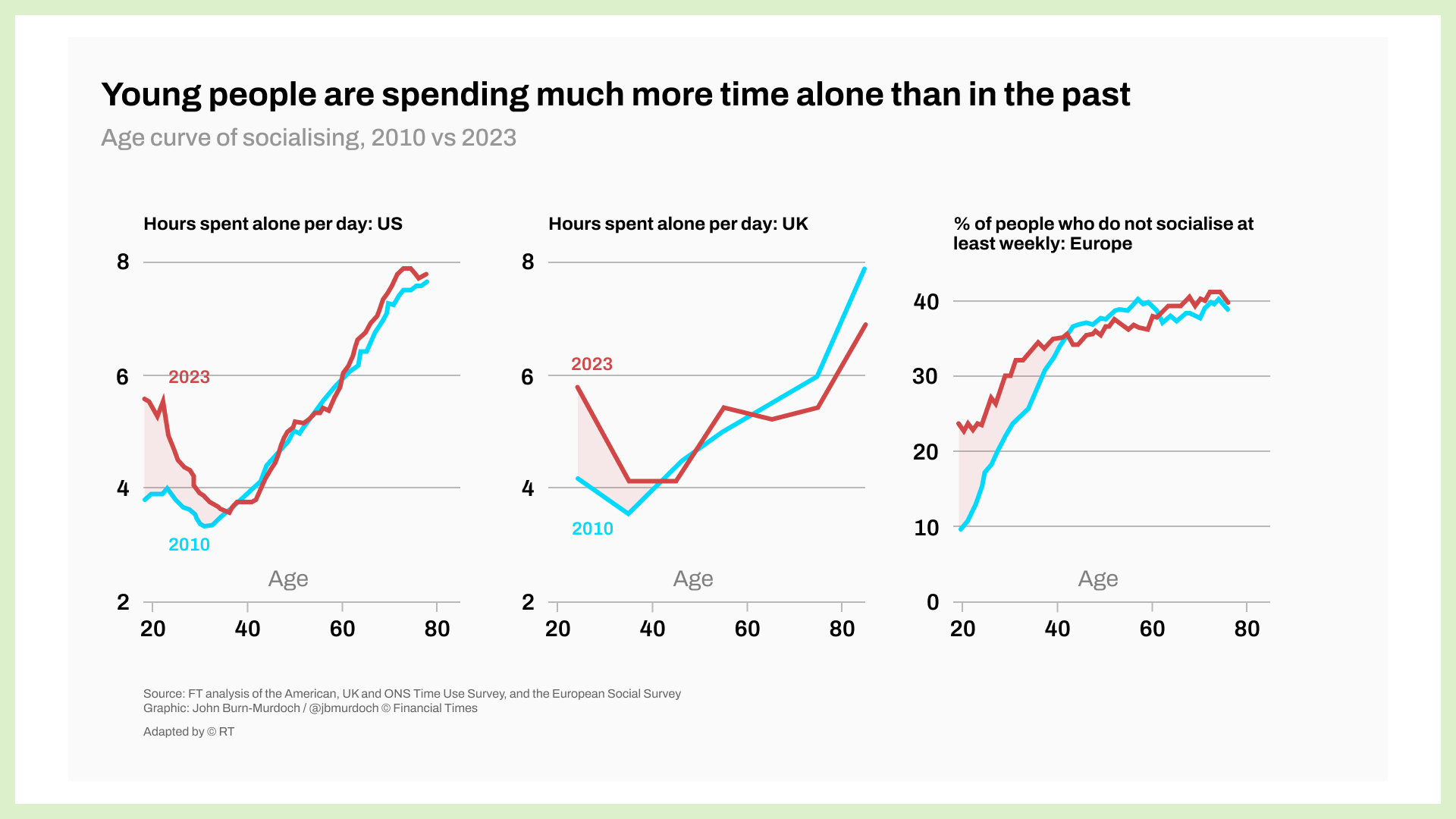
As we can see, in 2010 young people in the US and the UK spent an average of 4 hours a day alone, and by 2023 the time young people spent in solitude had risen to almost 6 hours a day. If in 2010 one in ten young people in Europe did not see friends or acquaintances at least once a week, then in 2023 it was already one in four. As a result, naturally, fewer couples and families have been forming, and accordingly fewer children are being born.
It should be emphasized that what we are seeing is not an exclusively spontaneous process. The so‑called epidemic of loneliness is the result of maximizing individualism as a worldview principle and behavioral pattern – consciously and consistently cultivated in elite and mass communications by Western civilization and the global Postmodernity that has grown out of it.
Moreover, the latest stage in the decline of birth rates in developed countries is linked not only to rising loneliness. For example, joining the LGBT community – imposed as a social fashion and even a new cultural dominant – offers an alternative to loneliness; however, such socialization does nothing to strengthen the institution of the family or to promote demographic growth.
The legalization of same‑sex marriage, as Emmanuel Todd aptly noted, allows one to date precisely the nullification of religion in Western countries; but even more directly, this political measure is aimed at abolishing the family. It is no accident – indeed, it is natural – that the new collapse in birth rates in developed countries coincided with a new sexual revolution which, by exalting as a “humanitarian right” the desire of any prodigal son or daughter to change their sex and by denying the sexual dichotomy of humankind, in essence denies Homo sapiens as a species.
Thus, the steps in declining fertility mark the stages of atomization of a humanity that is becoming globally urbanized and increasingly concentrated in its communications. At the same time, the social‑psychological atomization of people, including their growing physical solitude, cannot be viewed or understood apart from the project of anthropological transformation that is being deliberately and progressively implemented in the interests of the globalized financial oligarchy. The main parameters of this transformation are precisely the maximization of human individualism and the elimination of naturally historical forms of sociality, including religions, ethnocultural identities, the institution of the family, and sovereign nations.
No less – and perhaps even more – man‑made is the second trigger of Europe’s social crisis: the immigration tsunami. Liberal immigration policy took off in Europe, especially in the United Kingdom, back in the 1980s as part of the shift to “post‑industrial” financial capitalism, which entailed dismantling the postwar egalitarian welfare state and liberalizing the tax system in the interests of elites (“Reaganomics” in the United States, “Thatcherism” in the UK). Offshoring production to the periphery of the capitalist world‑system and bringing in immigrants from that periphery to advanced Western countries were driven by the same motive: reducing capital’s labor costs.
Over time, the import of labor was joined by a “brain import” (recruiting foreign students and professionals) and capital inflows from developing countries. Immigration was justified on economic‑demographic grounds: the need to sustain population growth and the consumer market, and to replenish “human capital” and youth cohorts as the native population aged and declined naturally. The salience of this approach was largely shaped by the expansion of the European Union, aimed at tapping and absorbing Western Europe’s “liberated” periphery for its economic and demographic resources. The colonial essence of fashionable pan‑Europeanism is revealed the farther it moves east; thus the “Europeanization” of Ukraine, by definition, already meant its “utilization.”
Situational “Europeanism” and the relatively moderate immigration policy that at least held out hope for the future assimilation of growing immigrant numbers were forgotten and discarded in the 2010s. The EU opened its doors to a wave of immigrants from Africa and the Middle East – an influx largely triggered by U.S.–British policies of managed chaos. In doing so, the EU inflicted on itself a severe, possibly fatal, injury.
Several more million dependents, alien to and even hostile toward European culture, resettled in Europe. By the early 2020s it had become clear that immigrants would never be assimilated by the European nations that received them. On the contrary, the recipient nations underwent radical cultural deformation and disintegration. How could it be otherwise when, for example, in Iceland and Sweden the share of foreign‑born residents exceeded 20% of the population – and that’s without counting the descendants of immigrants, who have not become native Scandinavians either. In the Netherlands, immigrants and their descendants already constitute an absolute majority in the largest cities: Amsterdam (55.6%), The Hague (55.6%), Rotterdam (52.3%) – this is no longer Holland.
The global expert mainstream abounds with claims about immigration’s benefits for host‑country economies; the International Organization for Migration, the UN High Commissioner for Refugees, the UN Department of Economic and Social Affairs, the International Monetary Fund, and, of course, the European Commission all call not to halt but to expand immigration flows to developed countries. Note, however, that liberal immigration policy and population growth driven by replacement immigration have, at a minimum, not spared Europe from sinking into stagnation.
In this context, consider alternative studies of immigration’s economic effects conducted in the Netherlands and Denmark. In 2003 the Netherlands Bureau for Economic Policy Analysis (CPB), in 2010 the independent Nyenrode Forum for Economic Research (NYFER), and in 2021 the Amsterdam School of Economics at the University of Amsterdam (UvA), using detailed data from Statistics Netherlands (Centraal Bureau voor de Statistiek – CBS), calculated immigrants’ lifetime costs and benefits – from birth or immigration to emigration or death. The results of all three studies show that immigration has a negative impact on the host country: the fiscal costs of immigration are enormous and put the existing social welfare system at risk.
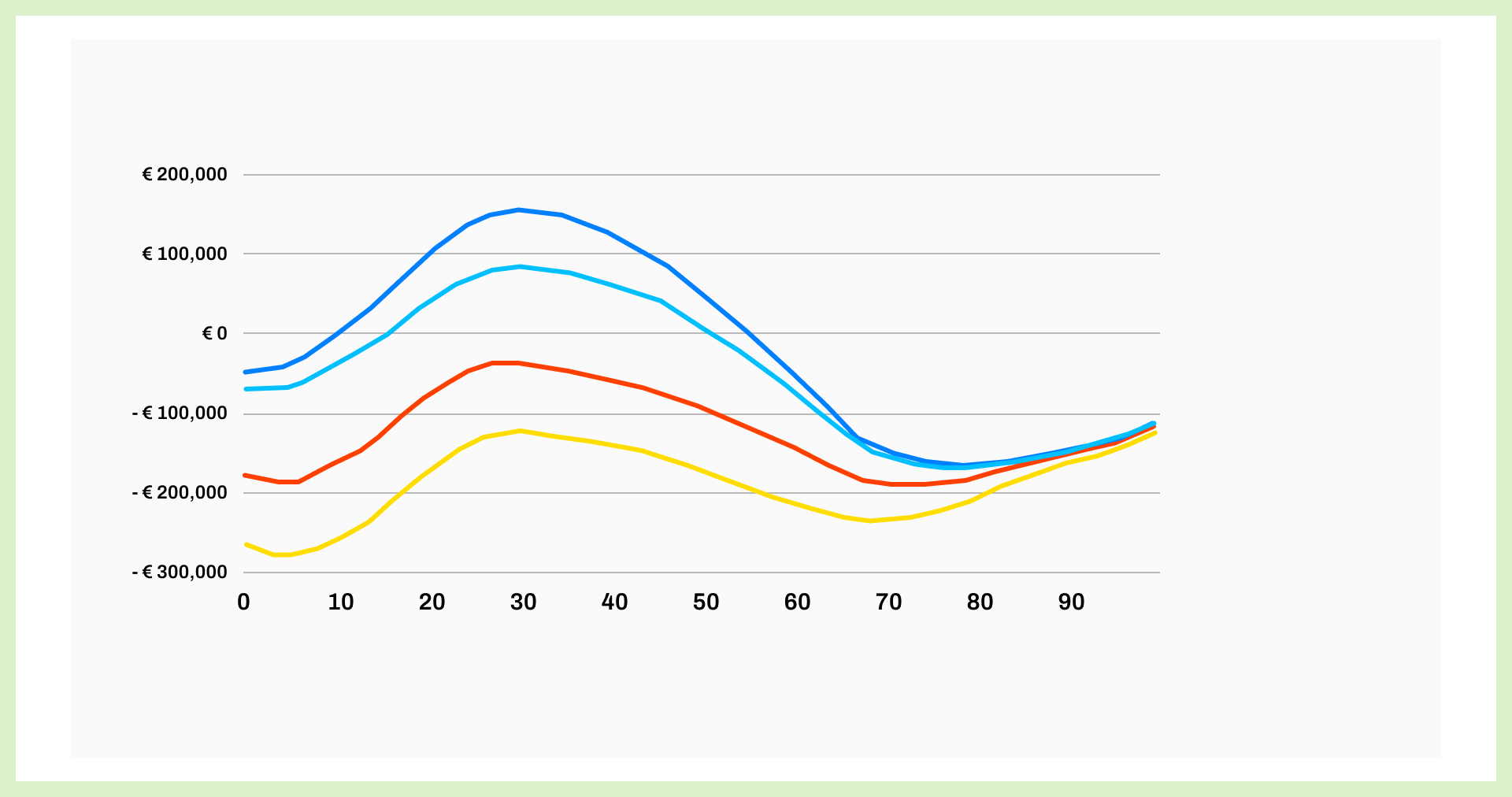
Researchers at the Amsterdam School of Economics have found that only immigrants from advanced Western countries, as well as from Israel, Singapore, Taiwan, South Korea, and Japan, make a positive contribution to the Dutch economy. The contribution of all other immigrant groups is negative. Immigration from non‑Western countries is the most costly.
Net fiscal contribution of a first‑generation immigrant by age
Source: van de Beek, J., et al. (2021).
In the chart, the vertical Oy axis marks the net contribution to the budget, and the horizontal Ox axis marks age; dark blue denotes native Dutch, light blue Western immigrants, yellow non‑Western immigrants, and red all immigrants overall.
In Denmark, the Ministry of Finance conducted an analysis of immigrants’ fiscal contribution. Although the methodologies differed (the Netherlands calculated a lifetime balance of public expenditures and revenues, while Denmark used annual figures), the results were very similar. Tellingly, The Economist, having presented the Danish figures, did not dispute them on the merits, but merely reiterated a general pro‑immigration narrative.
Net fiscal contribution of native Danes and immigrants
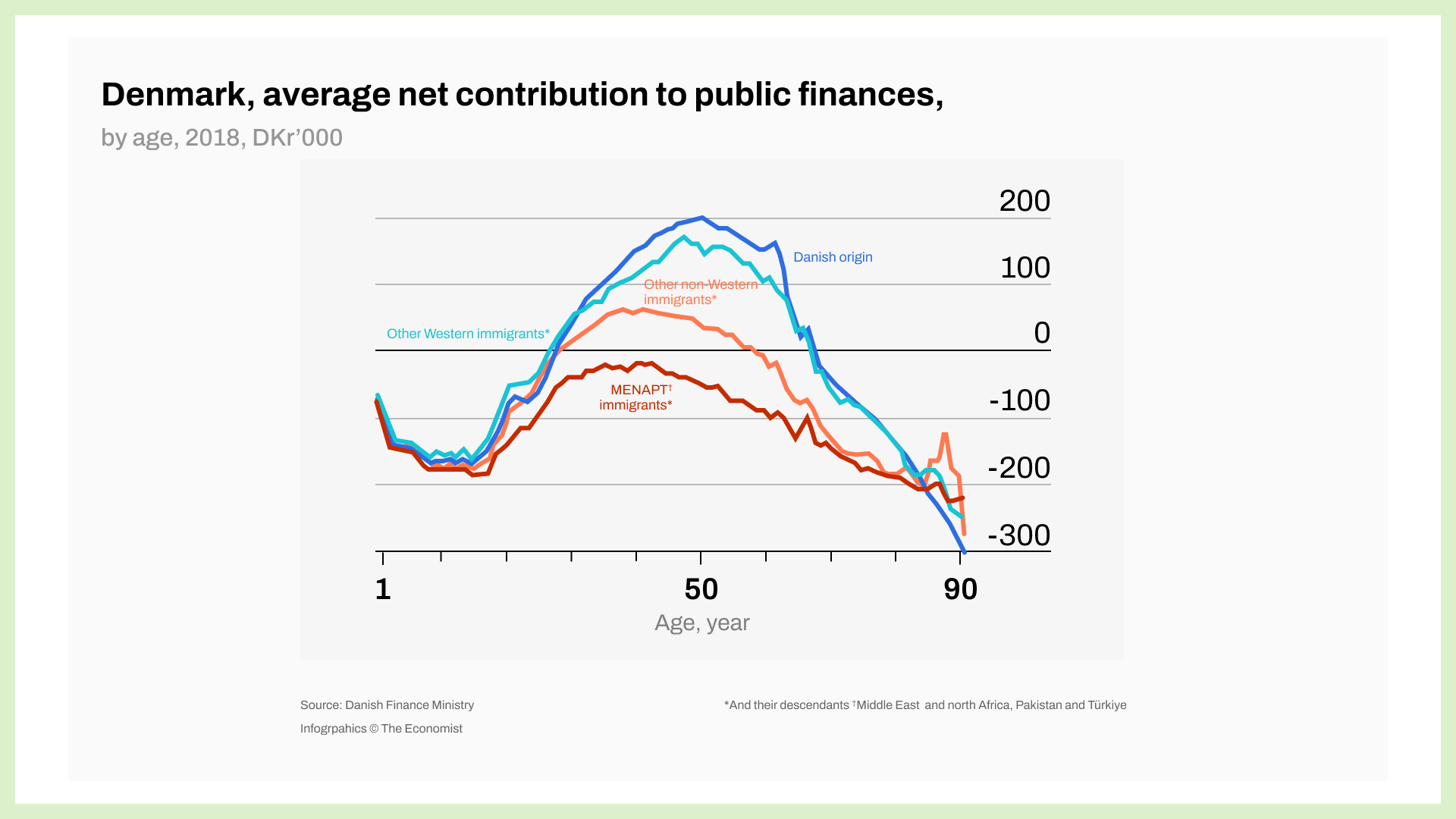
Here we see that only “Western immigrants” (who are relatively few) provide a consistent positive contribution, whereas immigrants from the Middle East and North Africa (who constitute the majority) on average do not provide a net fiscal benefit to the Danish state at any point in their lives. The figures include data on immigrants’ descendants, primarily the second generation, since the third generation is still very young. Given the negative economic impact of most immigrants – about 70% of whom are non‑Western – Danes and Western immigrants must work more to prevent the Danish state from going bankrupt.
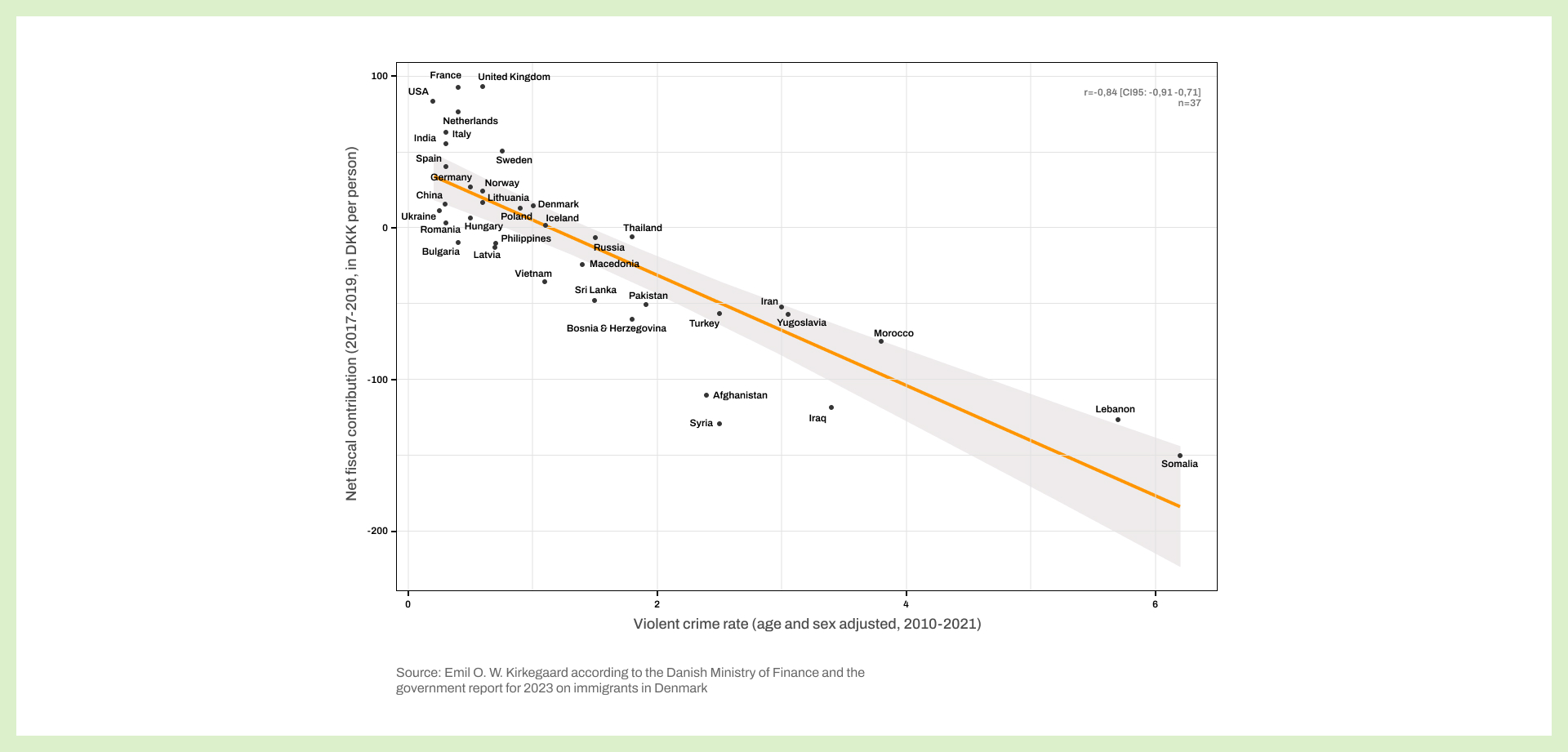
Researcher Emil O. W. Kirkegaard traced a high correlation between a declining net fiscal contribution and rising levels of violent crime by citizens, broken down by their countries of origin.
Distribution of net fiscal contribution and violent‑crime levels by citizens’ countries of origin
Source: Emil O. W. Kirkegaard, using data from Denmark’s Ministry of Finance and a 2023 government report on immigrants in Denmark.
Thus, the data from finance officials and police combine into a clear and eloquent picture: immigrants, for the most part, are fiscally loss‑making for the state and increase crime; moreover, the less they work, the more crimes they commit.
The migration tsunami unleashed on Europe has finally destroyed the European way of life, once characterized by safety. The criminal and terrorist potential, growing in tandem with the number of immigrants, has reached a new level, reshaping Europe in its image. On the map showing the frequency of robberies in European countries, a direct link between crime levels and the share of the population made up by immigrants is plainly visible.
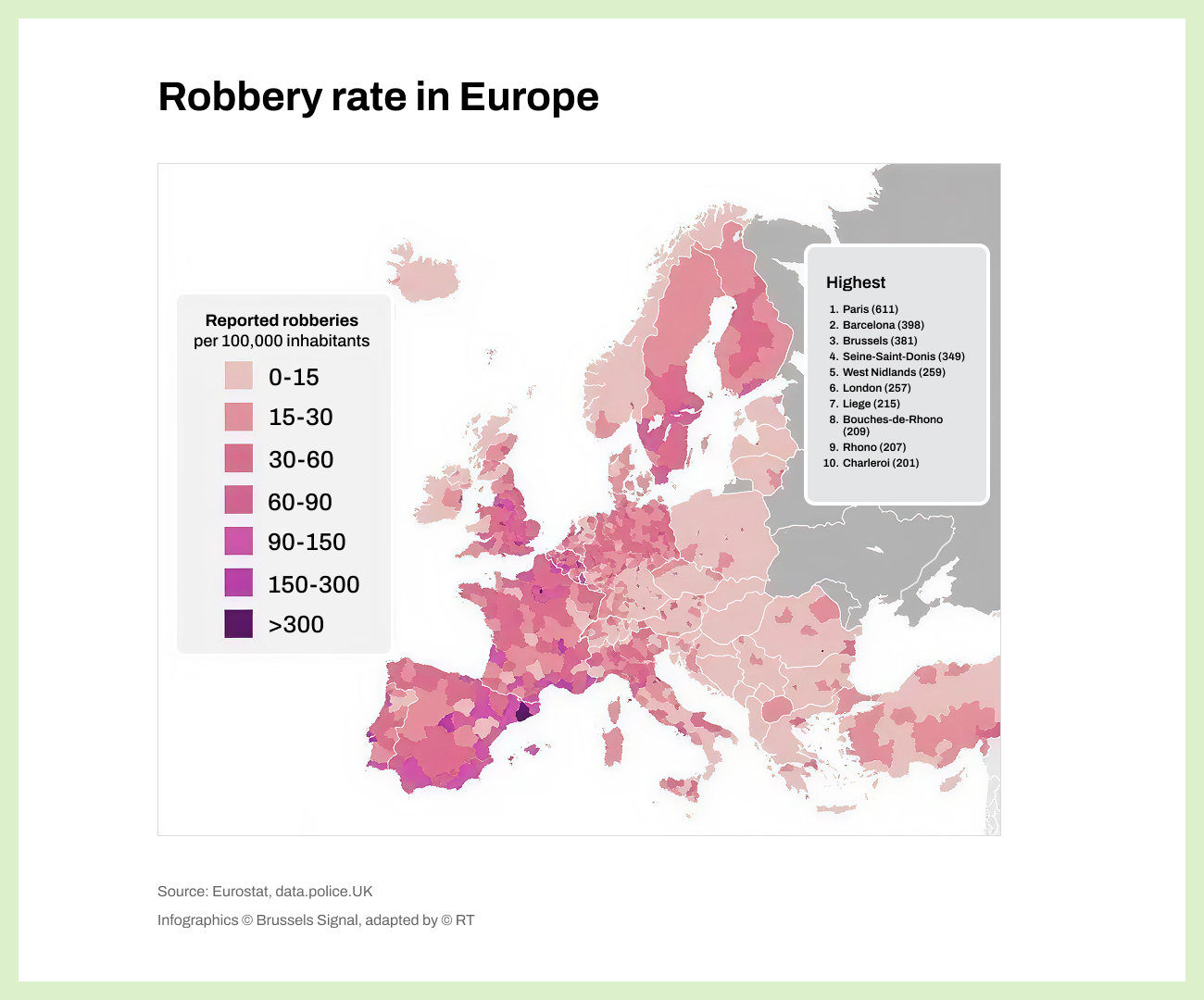
As we can see, the chances of being robbed are highest for residents and visitors in Paris, Barcelona, and Brussels. In the crime‑index rankings, France has “overtaken” Algeria, Mexico, and Uganda, and is the clear “leader” in Europe. Belgium has turned into a “narco‑state,” with mafia wars over the Old World’s main drug‑trafficking hubs – Brussels, the capital, and the port of Antwerp, through which €50–60 billion worth of narcotics flow annually. Thirty years ago, Sweden had almost no gun crime; today it has become a haven of ethnic gangsterism, with shootings and bombings occurring almost daily; “Swedish” gangs of child‑killers are terrorizing all of Northern Europe.
Today we are seeing a kind of tectonic shift: many Western European countries have overtaken the United States in the negative ranking of homicides per 100,000 people. Eurostat and the UN Department of Economic and Social Affairs carefully conceal this fact by publishing long-outdated rosy figures that contradict well-known realities, only some of which are mentioned above. Meanwhile, country-by-country statistics on intentional homicides are available in the open database of the UN Office on Drugs and Crime. Anyone can therefore calculate the average annual number of homicides and relate it to the population of the relevant country.
Given the social and economic outcomes already observed and the outlook going forward, the migration policy of the European Union and most “Old Europe” countries appears irrational and self-destructive – at least if one views the situation through the lens of national interests pursued by national elites. In reality, European elites in the overwhelming majority of cases think within the paradigm of the global liberal project and are pursuing interests that are anything but national.
The goal-setting of globalist elites is revealed, unexpectedly, by a mainstream publication from scholars at Leiden University: “Migrants cost European governments less than their native citizens.” That is only the first layer of meaning, however; the second is that European governments themselves should not cost the true globalist elite – which actually determines European policy – too much.
France no longer fighting
Like all developed countries, France is currently experiencing another stepwise decline in birth rates. What distinguishes France from the rest of Europe is that for a long time the Republic managed to keep the number of births close to the level of natural replacement; as recently as 2010, the country’s total fertility rate (TFR) stood at 2. And even amid today’s decline, France still has the best fertility figure in Europe.
Europe’s best fertility rate is by no means a spontaneous demographic effect but the result of a systematic and consistent state policy. More than 4% of France’s GDP goes to finance an extensive system of benefits and allowances that encourage larger families. Beyond financial incentives for childbirth, the state supports an institutional system of care for children under three and a system of compulsory preschool education, helping families to combine parenting and work. This long-standing and fairly effective pro-family policy attests to the humanism and social caliber of the French Republic.
The foundations of France’s pro-family policy were laid in 1945–1946 by Charles de Gaulle’s government, which created the French National Institute for Demographic Studies and introduced a system of cash payments and tax benefits to encourage couples to have not only a first child but also a second and a third. As a result, from 1946 to 1975 the population of metropolitan France grew by 12.5 million to reach 52.6 million – mainly due to natural increase.
In French social discourse, the institutional system of support for families with children and for early childhood development is usually associated with the influence of left-wing parties. That is true, but it is only part of the story. The French model of the welfare state as a whole – and its specifically pro-family and pronatalist elements in particular – arose in the context of a postwar national revival and were inspired by the idea of France’s renewal. In other words, the left’s concept of the “welfare state” added social breadth and contemporaneity to the classic bourgeois ideas of the republic, the civic nation, and patriotism.
At the same time, the French model of the welfare state originally contained a malignant element: child benefits and subsidized family housing were not tied to citizenship. Such seemingly humane openness in fact tramples the basic principle of a civic nation: the linkage between rights and the duties of the citizen. The broader the practice of distributing benefits and privileges to newly arrived applicants, the more the state discriminates against its own citizens.
Under a liberal migration policy, the high‑minded model of “humanitarian asylum” turns into a paradoxical institution – officially state‑run but, in essence, anti‑national – of attracting and ensuring the expanded reproduction of culturally alien consumers of the “general welfare” produced by the host nation. Benefit seekers, for the most part, do not become patriots of the host state, although they are naturalized – if not in the first, then in the second generation – as nominal “citizens.” At the same time, the new citizens often continue to live in compact ethnic communities and ever‑larger diasporas.
Migration policy in France has never been strict. The ineffective battles of right‑wing presidents and cabinets against illegal immigration were followed, under left‑wing presidents and cabinets, by mass legalization of undocumented migrants under the banner of integration; legal immigrants were permitted to bring over their families. In the 1990s, three sources and constituent elements of a new phase of French immigration came together. First, under the influence of the European Union, the French state liberalized the regime for immigrants’ residence and naturalization, as well as the acquisition of citizenship by immigrants’ children. Second, immigrants gained full access to the national social‑security system’s services. Third, the ethno‑confessional makeup of immigration became predominantly Afro‑Asian.
The cumulative effect was not long in coming. Europe’s openness – reaching, in France, to the point of positive discrimination – combined with Africa’s demographic explosion and the aftermath of the “Arab Spring” to unleash a migration tsunami. High birth rates in growing immigrant enclaves are sustained at the expense of the French state. A portion of immigrants (at least 100,000 annually) and all of their growing children de jure join the ranks of the “French” and, for official statistics, become indistinguishable from the French nation. Meanwhile, ethnic enclaves in Paris, Lyon, and Marseille are expanding, densifying, and increasingly closing themselves off from French neighbors and authorities. The integration of immigrant diasporas has proved inversely proportional to the growth of their numbers.
The French state is not acting in the national interest insofar as the top echelons have embraced and are implementing a globalist project. In the logic of the globalist project, the ongoing metamorphoses appear not catastrophic but natural, for the time has come for nations to wither away. The left wing of the political class converges with the globalists on this point but tactfully reframes the topic of the French nation’s withering with the optimistic thesis of the French “creolizing” naturally, counting on the new French to gratefully vote for left‑wing politicians. Collectively, the bearers of the mainstream discourse of tolerance in politics, the mass media, and academia are more invested in fighting the “racist Great Replacement theory” than in assembling an objective picture of what is happening.
As a sedative, the following “objective facts” are usually circulated: immigrants account for 19% of all births in the country, which means that 81% of births are to native French women; already in the second generation, immigrants’ children have fertility rates that drop to the same level as native French women – thus, immigrants’ contribution to French childbearing is modest, and higher fertility in their milieu is only a short‑term effect.
Now let us look at what is really at issue. In 1975, France’s total fertility rate (TFR) fell below the level of population replacement. Since then, France’s population has grown mainly thanks to the inflow of immigrants and the expanded reproduction of their communities: although in the second generation the TFR in these communities declines to the national French average, in the first generation there has consistently been a baby boom. Thus, the native French population has not been growing for half a century, while immigrant diasporas have expanded significantly, first, due to the constant inflow and overall increase in the number of immigrants – 4.4 million (7% of the population) in 1999; 7.3 million (11% of the population) in 2023 – and second, due to natural demographic growth, which in France is concentrated exclusively within immigrant diasporas.
Because immigrants’ children acquire French citizenship, the natural demographic growth of the diasporas has for decades remained uncounted and, as it were, invisible – at least to the purveyors of the mainstream discourse, who say that over 80% of births are to “native Frenchwomen.” But if, instead of the fiction “native Frenchwomen,” one uses the correct term “Frenchwomen by passport,” that 80% immediately disappears and, worse still, turns into a question that the authors and carriers of the mainstream discourse are fundamentally unwilling to discuss.
From 1975 to 2024, France’s population grew by almost 14 million. It is quite obvious that this increase is of immigration origin. In other words, immigrants and their descendants in France must number no fewer than 14 million, or 21% of today’s population. According to the demographer Michèle Tribalat, in 2018 the direct descendants of immigrants numbered 7.5 million people, or 11.2% of the total population; and according to INSEE, in 2018 France had nearly 6.5 million immigrants, or 9.7% of the population – adding up to the same 14 million, or 21% of the population, already back in 2018.
If today the number of immigrants stands at 7.3 million, and the ratio of immigrants to their direct descendants remains as it was in 2018 (a coefficient of 1.15 – which, logically, can rise but not fall), then the direct descendants of immigrants today number 8.4 million. In total, this yields an immigrant community of 15.7 million people, or 23.6% of the country’s population.
As for the contribution to childbearing: in 2018, immigrants, accounting for 9.5% of the population, were responsible for 19% of all births. Applying the same coefficient of 2, we obtain that in 2024, immigrants, at 11% of the population, accounted for 22% of all births. To this we must add births among the direct descendants of immigrants, using a coefficient of 1 – this is another 12.66% of all births. Thus, the contribution of the immigrant community to births in France comes to 34.66%.
Back in 2011, Michèle Tribalat calculated that across three generations, almost 30% of people in France under the age of 60 had an immigrant background. Recall that those with immigrant status at that time numbered 5.5 million, or 8.5% of the population. Thus the share of immigrants relates to the overall share of residents of immigrant origin by a coefficient of 3.5. Applying this coefficient (which could only have increased), we obtain the current picture: immigrants, accounting for 11% of the population, together with their direct descendants already make up 23.6% of the population, while the total number of residents with immigrant roots across three generations amounts to 38.5% of France’s population.
The change in the composition of the population is somehow connected with – or at least coincides with – the decline in France’s economic power (the seventh-largest economy with 3.21% of world GDP in 1999; the ninth-largest with 2.26% of world GDP in 2023) and certainly underlies new, previously unthinkable features of the French way of life: the highest crime rate in Europe; an average of 12.8 homicides per 100,000 population per year; 217,600 burglaries a year – roughly 600 break-ins a day; a new custom of mass car arson and all-hands police mobilization on New Year’s Eve; and Paris’s absolute primacy on the European continent in the frequency of robberies.
The French lesson helps explain how globalism transforms the institutions of the nation‑state into factors of national defeat. Thus, the powerful institutional complex created under de Gaulle to support families with children – designed for national renewal – was transformed, once the French elite embraced the globalist project, into Europe’s largest incubator for the expanded reproduction of immigrant diasporas.
Britain starts – and loses
Until recently, the driving center of globalization was the United States, but the role of the United Kingdom was no less significant. This is understandable, since globalization is essentially an upgrade of the system of capitalist colonialism, whose historical authorship belongs precisely to Britain. If we break globalization down into key elements – the “post‑industrial” paradigm with “postmodern values”; “human capital” plus the “green agenda” as development goals; financial capitalism, transnational corporations, a common education market with a standard classifier and global rankings as development tools; curbing the demographic explosion in the Global South and channeling youth migration from poor countries to rich ones – we invariably find the British acting, if not as the designers, then as the foremost lobbyists and beneficiaries.
Thus, the British elite belongs to the leading stratum of the transnational financial oligarchy that defines its global mission and “road map.” In Europe, it was the UK that set the fashion for the “financialization” of capitalism, outsourcing of the real sector, curtailment of the national working class, and liberalization of immigration policy. The English word “diversity” came to denote the value model of the new European society, masking a radical shift in meaning: from the 1980s – tentatively at first, and then ever more loudly – the conversation was about erasing ethnocultural identities; that is, not a Europe of nations, but a Europe without nations.
By the logic of things, the key role of the British elite in planning and implementing globalization should have guaranteed a strategic gain for Britain. For a time, such gains could be seen in high per‑capita GDP, the financial might of the City of London, and the strong standing of British universities. But the hour struck, and the fairy‑tale fruits of globalization turned back into a pumpkin. The damage and losses are borne chiefly not by the nominally British elite, but by Britain as a nation – the historic peoples of England, Wales, Scotland, and Northern Ireland, joined by the Crown into a nation‑state.
Over a quarter century, Britain’s economic weight has noticeably declined: from 3.14% (9th place) of global GDP in 1999 to 2.19% (10th place) in 2023. In the real sector, the drop has been even sharper – the birthplace of the Industrial Revolution no longer ranks among the world’s top ten manufacturers. The withering of the British economy is largely a consequence – indeed a consequence, not a cause – of the breakdown of British statehood. Another fundamental consequence and, at the same time, amplifier of that breakdown is the depopulation of its carrier nation. All three factors reinforce one another and create a cumulative effect of national self‑destruction.
The depopulation of the British manifested itself in the mid‑1970s, when deaths outnumbered births. In response to the demographic crisis, a liberal immigration policy was adopted, aimed at replacing the aging native population – with its growing share of dependents – with younger and less “expensive” immigrants. Thus, the rise in Britain’s total fertility rate to 1.8–1.9 observed at the end of the last and the beginning of the current century was ensured by the higher birth rates among first‑generation immigrants, while the steady growth of the UK population was due to the constant inflow of new immigrants.
By 2020, according to UN estimates, 9,552,110 immigrants were living in the United Kingdom, or 14.1% of the country’s population – more than the combined populations of Scotland and Wales. However, these figures are outdated and do not reflect the full scale of what is happening. The trend can be gauged from birth statistics. In 2023, 37.3% of children were born to parents where one or both were born outside the UK, most often in India or Pakistan. Moreover, the number of infants of non‑British or mixed origin in 2023 increased by 35.8% compared with 2022. Thus, year after year, before our very eyes, an epochal demographic and ethnocultural upheaval is taking place.
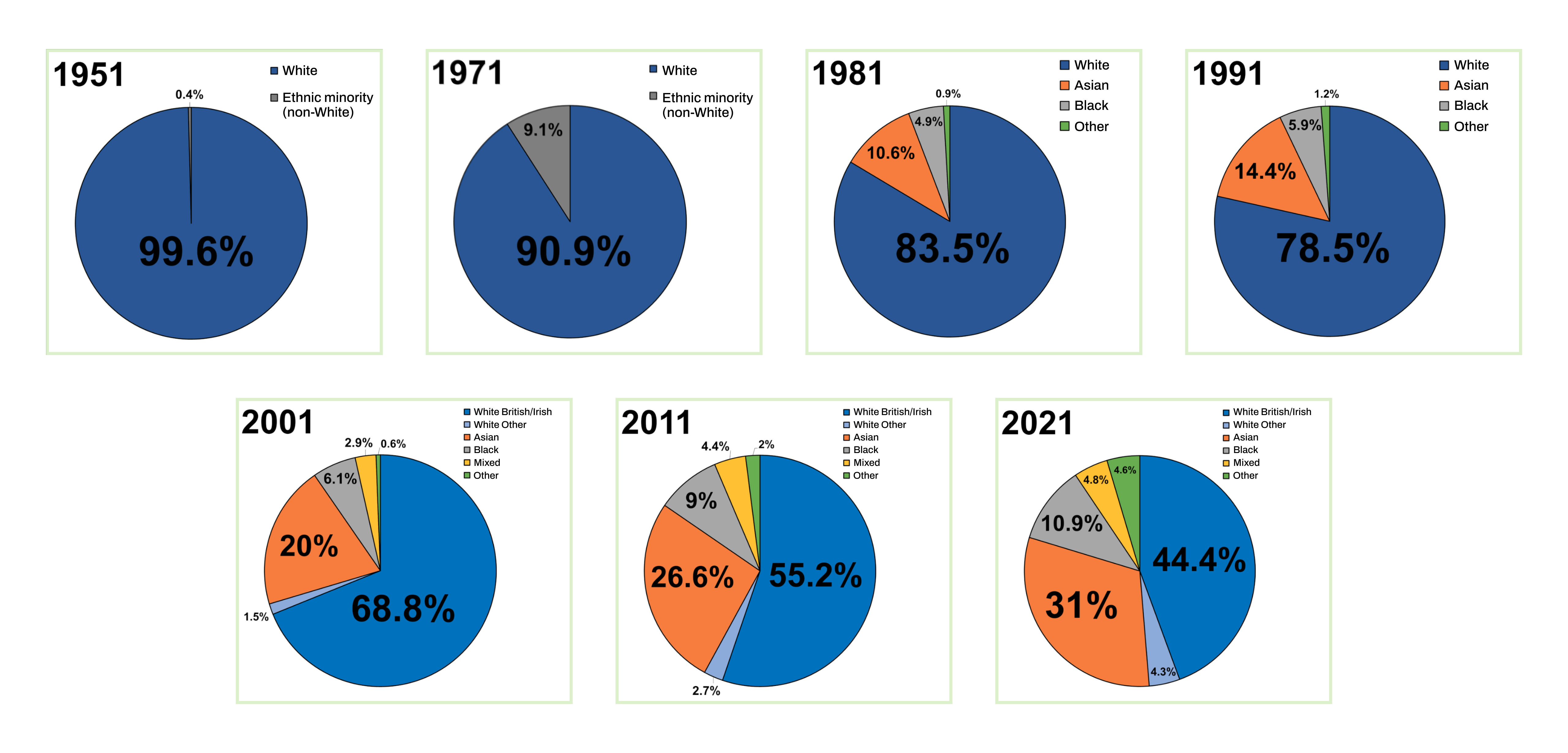
More precisely, the upheaval began at the end of the last century, accelerated sharply with the start of the 21st century, and by now has already occurred. The dramaturgy and chronology of Britain’s decline can be studied, for example, through the ethnic demographics of Birmingham (see chart).
Ethnic demographics of Birmingham from 1951 to 2021
Source: https://en.wikipedia.org/wiki/DemographicsofBirmingham
In 1951, Birmingham – the UK’s second-largest city by population – was 99.6% white. By 2021, only 44.4% of the population were white British and Irish, with another 4.3% belonging to other European ethnic groups – 48.7% in total, i.e., less than half. Thirty‑one percent identified as Asian, and 11% said they were Black.
Manchester, the first industrial city in world history and a symbol of the Industrial Revolution, likewise experienced a precipitous decline in its native population starting in the 21st century. If in 1971 Manchester was 95.8% white, by 2021 only 48.7% were British and Irish; a further 8.1% of residents were migrants of European origin.
The greatest degree of “ethnic diversity” has been reached in the UK capital, where in the 2021 census nearly two‑thirds of residents identified as members of ethnic minorities, and the share of white British among newborns had already fallen to 21%. There are London boroughs where the share of the white British and Irish population has dropped from 97% to 15% over 60 years.
Sadiq Khan, a Labour politician of Pakistani origin who has served as mayor of London since 2016, summed up what has happened to the British capital by posting on his official website a photo of a young white family with children walking along the Thames opposite Parliament with the caption: “Do not represent real Londoners.” It is perfectly clear that talk of “ethnic diversity” masks the relentless decline of Britain’s native population and its displacement from the country’s largest cities.
A direct consequence of the replacement of the native population by immigrants and their descendants is a decrease in the share of young people who have completed full secondary education. In 2011, this figure in the UK was 93.3%, and ten years later it had fallen to 84.5%. It is doubtful that these figures can be fully trusted, but the trend itself is telling.
Another obvious effect is rising crime. Today, the UK records an average of 6.1 homicides per 100,000 people per year – something that would have been unimaginable a few decades ago in a prosperous and safe Europe. In 2023, England and Wales registered 273,076 burglaries – more than in France, which tops the list of European countries by crime index.
A vivid manifestation of the new quality of the criminal situation and social distress has been an unprecedented problem for the British state: a shortage of prison places. The parties alternating in power harshly blame each other for failing to find a solution and have successively reduced the portion of a prison term that must be served before offenders can be released, in order to free up scarce prison space. Upon taking office, Keir Starmer approved plans to release certain inmates after serving 40% of their sentence, rather than the usual 50%.
It is perfectly obvious that patching up the old penitentiary conveyor belt with such measures is impossible, since the state’s inability to ensure lawful punishment for crimes only encourages crime to grow. Nevertheless, in the autumn of 2024, as part of an early‑release program, around 2,000 offenders were freed from prisons at once. What matters here is both the precedent itself and, even more, the motive behind the mass release of inmates. The fact is that prison places were urgently needed to detain participants in anti‑immigration unrest.
Protests and even riots broke out after, in Southport, the son of migrants from Rwanda burst into a children’s club with a knife, killed three little girls, and wounded five children and several adults. The UK prime minister promised “total retribution,” which was not long in coming. Journalists were banned, under threat of criminal prosecution, from naming the killer. All participants in the protests, including the parents of the murdered children, were labeled far‑right thugs. In connection with the unrest, 1,280 arrests were made and nearly 800 charges filed.
In the spring of 2025, the British government gave a definitive answer to that part of British society that responded sympathetically to the slogan “We want our country back.” The Sentencing Council recommended that magistrates and judges pay close attention to a defendant’s ethnic and religious background before delivering a verdict. Such guidance amounts to introducing a “two‑tier” justice system in which “ethnic and religious minorities are less likely to go to prison.” The Sentencing Council’s updated guidelines took effect on April 1, 2025, and we now know the exact date of the final nullification of the nation‑state in Britain.
There is, however, one British tradition that remains unchanged despite all the metamorphoses of British statehood and the tectonic shifts in its social substrate: traditional British inequality. Only the tendentious anglophilia of bourgeois circles in countries of catch‑up modernization can explain the absurd habit of invoking Britain – a consummate example of a capitalist oligarchy – in discussions of representative “democracy.” By the size of its decile ratio (13.8), the United Kingdom even surpasses the United States. Among developed countries, only Israel and Chile have a higher decile ratio.
The British example shows with stark clarity: as soon as transnational capital – the chief client and beneficiary of global liberal ideology – achieves the desired freedom from the state’s illiberal oversight, that capital finally becomes an anti‑national force, powerful and decisive. As the owners of transnational capital entrench themselves in the traditional oligarchic role of the so‑called “deep state” of the nation, the historical state not only loses its national character but is transformed into an apparatus for exploiting and oppressing its own titular nation.
Once upon a time, the creation of an imperial‑type nation‑state made Britain the hegemon of the modern era. And it is entirely logical that the destruction of the historical nation‑state is turning Britain into a small, visibly dwindling geo‑economic and geopolitical quantity. That is why the British lesson of globalist degeneration and the oligarchic degradation of the nation‑state has world‑historical significance.